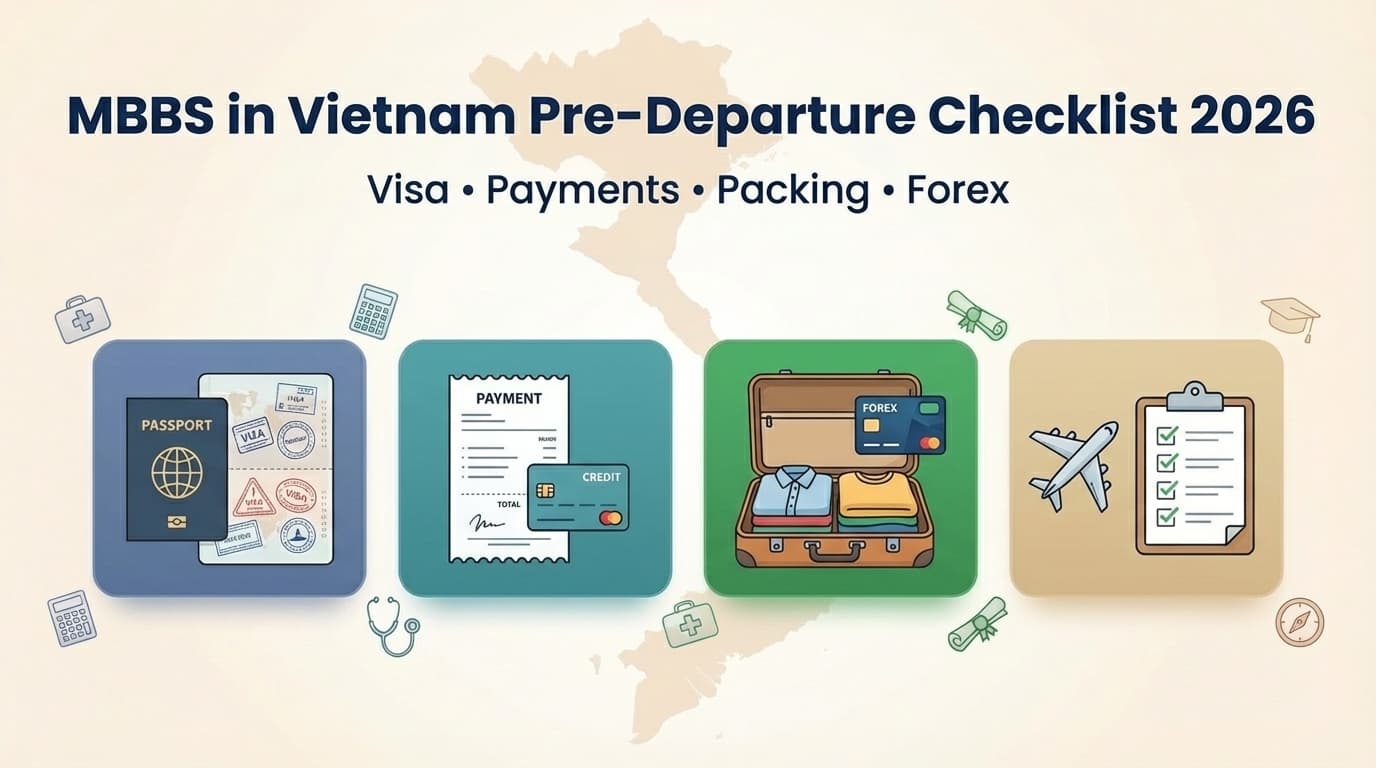
Why the Pre-Departure Stage Deserves Its Own Guide
Many families think the hard part ends after the offer letter.
In reality, one of the highest-risk phases begins after admission:
- fee transfers
- visa coordination
- hostel confirmation
- forex planning
- document packing
- airport and arrival setup
This is the stage where avoidable mistakes create the most stress.
Students miss documents. Parents transfer money without organizing proof properly. Hostel expectations are left vague. Important items are packed late or not at all.
That is why a serious Vietnam plan needs a pre-departure checklist, not only an admission checklist.
This article is built for Indian students leaving for Vietnam in the 2026 cycle and should be read together with MBBS in Vietnam Admission 2026, MBBS in Vietnam Fees 2026, and MBBS in Vietnam Student Life 2026.
Step 1: Understand What Usually Gets Paid Before Departure
The pre-departure payment image you shared is useful because it separates marketing talk from real cash outflow.
Across DNU, Dong A, BMU, and PCTU, the chart shows that families are typically being asked to clear:
- university registration fee
- one-time charges
- first-semester tuition
- first-year hostel
- caution deposit
2026 pre-departure totals from your chart
| University | Total payable before departure |
|---|---|
| DNU | $8,039 |
| Dong A | $9,222 |
| BMU | $9,372 |
| PCTU | $9,472 |
The important note on the chart is even more useful:
Students are advised to clear the university's first-semester fee and the first-year hostel fee before departure.
That means the pre-departure stage is not only about visa paperwork. It is also a financial sequencing stage.
Step 2: Build a Four-Folder Document System
Students should not travel with one random pile of papers.
Use four clearly separated folders:
Folder 1: Core originals
- passport
- Class 10 and 12 marksheets and certificates
- admission or offer documents
- university fee receipts
- birth-related ID documents if applicable
Folder 2: Travel and visa papers
- visa-related paperwork
- flight ticket
- insurance proof
- airport pickup or arrival instructions
- hostel confirmation
Folder 3: Photocopies
- multiple passport copies
- multiple visa copies
- academic document copies
- fee-receipt copies
Folder 4: Digital backups
- cloud folder with scans
- phone offline copies
- copies emailed to parent and student
This sounds basic, but document chaos is one of the most common first-week problems.
Step 3: Do Not Treat Visa as a Last-Minute Formality
Families sometimes relax too early once the admission side looks complete.
That is risky.
Visa readiness depends on:
- document correctness
- name consistency
- timing
- payment proof
- communication discipline
Students should confirm:
- what exact visa stage they are in
- whether health insurance is part of the processed one-time charges
- what papers they need to carry physically
- whether any university-side arrival confirmation is required
The earlier the family becomes precise here, the easier the final week becomes.
Step 4: Freeze Hostel Reality Before You Fly
Families often assume hostel is solved because the university brochure mentioned it.
That is not enough.
Before departure, the student should know:
- whether the booked room is 2, 3, 4, or 6 sharing
- whether that room type is guaranteed or only requested
- whether boys and girls are housed separately
- whether the hostel is on campus or nearby
- whether electricity is included or billed separately
- whether meals or Indian food support exist
This matters because the first week feels very different depending on whether the student lands into:
- a confirmed room
- a temporary arrangement
- or a not-fully-decided allocation
That is a major quality-of-life difference.
Step 5: Create a Payment Proof Trail
Never rely only on "the transfer has been done."
Families should keep:
- transfer slip
- bank acknowledgement
- fee breakdown
- currency conversion note if relevant
- written confirmation of what the payment covered
This is especially important when the same departure cycle includes:
- registration fee
- one-time charges
- tuition
- hostel
- caution deposit
If a dispute or confusion happens after arrival, payment proof becomes one of the first things everyone asks for.
Step 6: Plan Forex for the First Month, Not Just the Flight Day
Forex planning is often treated too casually.
Students need money not only for landing, but for:
- local transport
- first small purchases
- SIM and data setup
- food adjustments
- emergency buffer
- basic room and study needs
The right question is not "How little cash can I carry?"
It is:
"How do I make sure the first 2 to 4 weeks feel stable even if local setup takes time?"
That means thinking about:
- cash
- international card usability
- emergency backup source
- parent access to the payment history
Step 7: Pack for Routine, Not for Panic
Students often overpack dramatic things and underpack daily essentials.
High-value items to prioritize
- prescription medicines with a simple written list
- a few days of familiar food backups
- basic stationery and notebook setup
- weather-appropriate daily clothes
- comfortable footwear for long campus days
- universal chargers and adapters if needed
- essential toiletries for the first week
Common packing mistake
Families spend too much time on decorative extras and too little time on:
- organized paperwork
- medicines
- digital backups
- first-week clothing and comfort items
The first week is not about looking fully settled. It is about functioning smoothly.
Step 8: Prepare the Phone Before Leaving India
The student should not land with a half-working device setup.
Before departure:
- clean up storage
- back up important photos and documents
- save emergency contacts offline
- pin important university and coordinator contacts
- enable international payment or OTP readiness where needed
- keep maps, documents, and scans accessible even without strong internet
This small step removes a surprising amount of first-day stress.
Step 9: Know the First-Week Tasks Before the First Week Begins
The student should already know what the first week is supposed to contain.
That usually includes:
- airport pickup or route to hostel
- check-in or room allocation
- local SIM or data setup
- university reporting
- original-document verification if needed
- local orientation
- fee or receipt cross-check
When these steps are unclear, the student feels lost even if everything is technically fine.
Good pre-departure guidance turns the first week into a sequence, not a shock.
Step 10: Parents Should Have Their Own Checklist Too
Pre-departure is not only for the student.
Parents should keep:
- scanned document folder access
- payment proof copies
- flight details
- hostel address
- coordinator and university contact list
- emergency escalation order
The calmer the parent system is, the calmer the student usually feels.
A Simple 7-Day Countdown
7 days before departure
- verify passport, visa, and ticket
- verify university and hostel payment status
- prepare medicines and document copies
3 days before departure
- recheck baggage
- confirm arrival communication
- keep forex and payment tools ready
1 day before departure
- keep all originals in hand baggage
- save digital copies offline
- charge devices and power bank
- sleep early and reduce last-minute confusion
That simple countdown removes most avoidable chaos.
Most Common Pre-Departure Mistakes
The mistakes that create trouble most often are:
- unclear hostel allocation
- messy payment proof
- missing photocopies
- no digital backup
- weak medicine preparation
- overpacking clothes and underpacking essentials
- assuming airport arrival is self-explanatory
The good news is that none of these are difficult problems. They are only difficult when discovered late.
Final Takeaway
Admission gets the student into Vietnam.
Pre-departure discipline is what gets the student there calmly.
The families who handle this stage best are not the ones who do the most. They are the ones who stay organized:
- fee proof clear
- documents layered properly
- hostel confirmed
- visa tracked
- first week understood
That is how departure stops feeling like a scramble and starts feeling like a controlled transition.
Frequently Asked Questions
Q: What fee is usually paid before departure for MBBS in Vietnam?
Typically the registration fee, one-time charges, first-semester tuition, first-year hostel, and caution deposit, depending on the university's structure.
Q: Should the student carry original documents to Vietnam?
Yes, but they should also carry photocopies and maintain digital backups in multiple places.
Q: Is hostel always fully confirmed before departure?
Not automatically. Families should confirm the exact sharing type and whether the room is guaranteed.
Q: How much forex should a student plan for?
Enough to cover the first few weeks smoothly, including small setup costs and emergency buffer, not just airport expenses.
Q: What matters most in the first week after arrival?
Document control, hostel settlement, communication setup, university reporting, and keeping receipts and contacts organized.
Related: MBBS in Vietnam Admission 2026 | MBBS in Vietnam Fees 2026 | MBBS in Vietnam Student Life 2026 | Best Cities in Vietnam for Indian Medical Students
How Students Traffic Can Support Your Vietnam Shortlist
Students Traffic works as an admission support partner for Indian families comparing MBBS in Vietnam. The focus is not to push one university blindly. It is to help students compare cities, fee structures, clinical pathways, and paperwork before money is committed.
If you want a cleaner shortlist, use Students Traffic's peer connect to speak with students already studying abroad and reach out for admissions guidance when you are ready to move from research to application.