Why This Admission Guide Matters
Many families lose time because they ask the wrong first question.
They ask, "Can my child get admission in Vietnam?"
That is usually the easy part.
The harder and more important question is:
Can the student get admission into the right university, with the right documents, on the right timeline, without creating downstream problems for visa, hostel, budgeting, or India-return planning?
That is what this article is designed to answer.
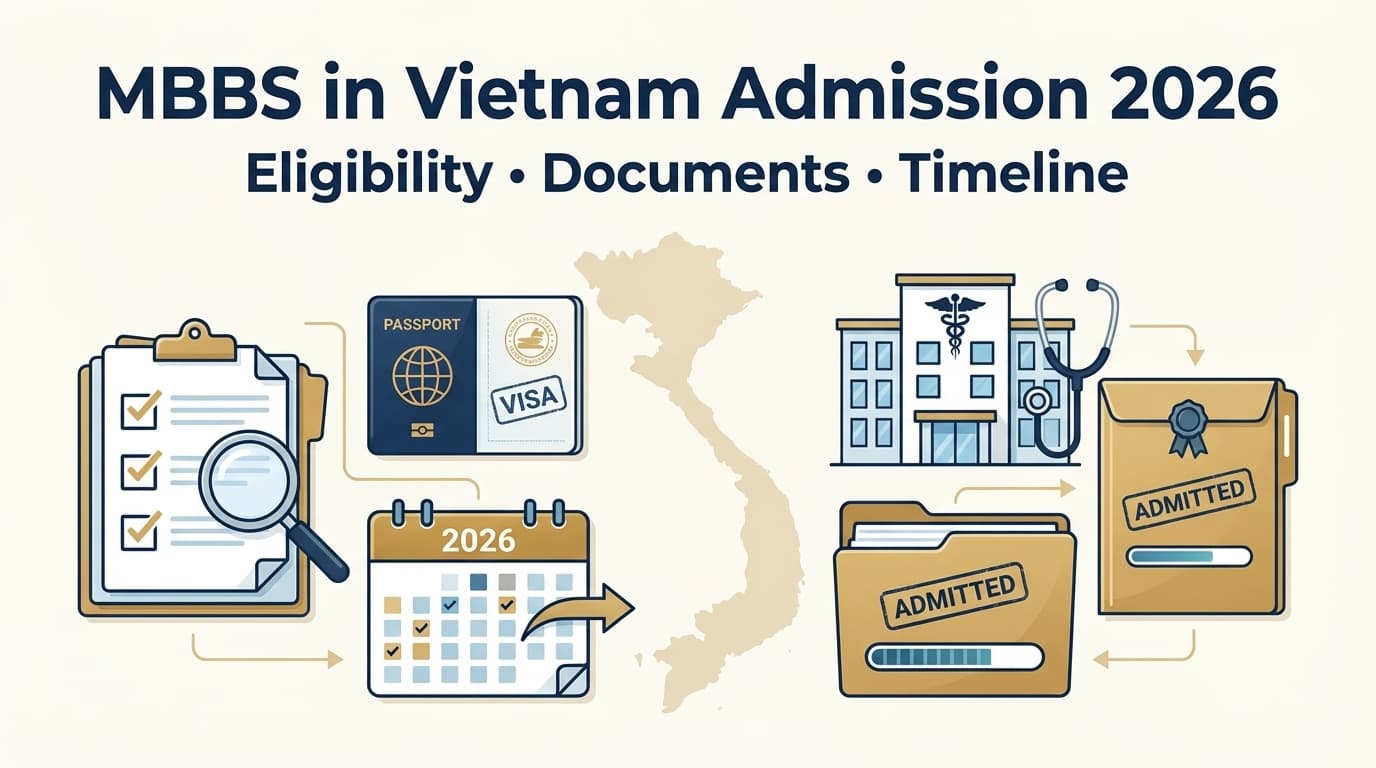
This is not a generic "apply now" article. It is a practical admissions guide for Indian families comparing Vietnam seriously in the 2026 cycle.
It should be read together with MBBS in Vietnam 2026: Universities, Fees & What Indian Students Need to Know, Best Medical Universities in Vietnam 2026, and MBBS in Vietnam Fees 2026.
Quick Answer: Who Can Usually Apply?
Most Indian students exploring Vietnam medicine in 2026 fall into one of these buckets:
- students who completed Class 12 with Physics, Chemistry, and Biology
- students who want a lower total-cost pathway than many private options elsewhere
- students who are comparing public and private universities across Hanoi, Da Nang, Can Tho, and regional cities
- families who want a shorter flight and easier geography than Eastern Europe
That said, "can apply" is not the same as "should apply."
Families should filter candidates through four screens:
| Screen | What to check practically |
|---|---|
| Academic baseline | PCB performance should be strong enough for a medical pathway, not just barely acceptable for an admissions agent. |
| NEET relevance | If India-return remains part of the long-term plan, NEET should be treated as central, not optional. |
| Budget readiness | Tuition is only one layer. Registration, one-time charges, hostel, electricity, travel, and city life must be planned together. |
| Language and maturity | Vietnam can work well, but students need the maturity to handle a different language environment during later clinical exposure. |
If a family is unclear on any of those four areas, admission should pause until the decision becomes cleaner.
Which Vietnam Universities Are Families Usually Applying To?
For Indian students, admissions discussions usually narrow into two broad groups.
Public-style and government-route comparisons
- Hanoi Medical University
- University of Medicine and Pharmacy of Ho Chi Minh City
- Hue University of Medicine and Pharmacy
- Can Tho University of Medicine and Pharmacy
- Thai Nguyen University of Medicine and Pharmacy
Private-route comparisons
- Phan Chau Trinh University
- Duy Tan University
- Dai Nam University
- Dong A University
- Buon Ma Thuot Medical University
The admissions workflow may feel smoother in some private universities because the counselling structure is more responsive. But families should never mistake administrative smoothness for academic fit.
The correct order is:
- decide the right university profile
- confirm fee and city fit
- validate long-term India-return logic
- only then submit and pay
Core Eligibility Checklist for Indian Students
The exact list can vary by university and intake, but most students should prepare for this eligibility baseline:
| Area | Practical expectation |
|---|---|
| Age and schooling | Student should have completed the school level required for medical admission and be ready for a full-time six-year pathway. |
| PCB background | Physics, Chemistry, and Biology should be part of the Class 12 profile. |
| Passport readiness | A valid passport is essential before the later stages of processing and travel. |
| Financial readiness | Family should be able to fund the first major payment cycle without last-minute scrambling. |
| India-return planning | If the goal includes practising in India later, NEET and document discipline should be treated seriously from day one. |
One important point:
Do not build the whole plan around the assumption that every Vietnam university has identical admissions standards.
Some families hear "Vietnam is easier" and stop evaluating. That creates avoidable errors.
Document Checklist: What Families Should Start Collecting Early
A strong admission file is usually built in layers, not all at once.
Academic documents
- Class 10 marksheet
- Class 12 marksheet
- provisional pass document if final school paperwork is still being issued
Identity and travel documents
- passport
- passport-size photographs
India-return and planning documents
- NEET scorecard where relevant to the student's India-return plan
- name and date-of-birth consistency across documents
Processing-stage documents that may enter later
- medical fitness paperwork
- document attestation or legalization where required
- police clearance or supporting declarations if the university or visa stage asks for them
- guardian or sponsorship paperwork depending on the processing model
The exact bundle should always be finalized university by university. But families who wait until the offer letter stage to start document gathering often create their own delays.
A Realistic 2026 Timeline for MBBS in Vietnam
The most efficient families start early enough to make good decisions without panic.
April to June 2026: shortlist and screening
This is the best phase for:
- comparing public versus private options
- deciding between Hanoi, Da Nang, Can Tho, and regional cities
- understanding tuition and hostel structure
- checking India-return documentation logic
June to July 2026: document assembly and application filing
This is when the family should already know:
- target universities
- budget range
- first-choice city
- whether the student is comfortable with the likely language environment later in the course
July to August 2026: offer letter and payment planning
This phase usually creates the most confusion.
An offer letter is not a substitute for full due diligence. Before paying, families should still confirm:
- what exactly has been offered
- what the first major payment includes
- whether hostel is confirmed or only expected
- how pre-departure costs are separated from full academic cost
August to September 2026: visa, travel, and hostel finalization
This is when weak preparation becomes expensive.
Families who still do not know the fee structure, room-sharing type, airport city, or arrival sequence at this stage are usually operating too late.
How the Offer Letter Process Usually Feels in Practice
Families often assume that once a university says "admission confirmed," the major work is over.
Usually, the opposite is true.
A practical admissions journey often looks like this:
- university shortlist is finalized
- documents are submitted for academic screening
- eligibility is reviewed
- offer or admission communication is issued
- first major payment planning begins
- visa and travel processing follow
- hostel and arrival support get finalized
The dangerous mistake is paying fast and questioning later.
The safer approach is:
- read the offer carefully
- match it against the fee sheet
- confirm hostel assumptions
- confirm city and training model
- then pay
Public Versus Private Admission: What Changes?
The surface process may look similar, but the family experience can feel different.
| Type | Admission experience tends to feel like |
|---|---|
| Public universities | More institution-led, less sales-driven, and often stronger on legacy but less hand-held in communication. |
| Private universities | More guided, faster in counselling flow, and easier for families who want more structured support during application and departure. |
That does not make one universally better than the other.
It simply means families need to know what they are prioritizing:
- prestige and public-school depth
- or support, flexibility, and a more managed process
The Four Admission Mistakes That Delay Departure
1. Choosing the university after paying the first amount
This sounds obvious, but it happens often. Families commit emotionally to "Vietnam" before choosing the right university inside Vietnam.
2. Treating the fee sheet as the full decision
Admission is not only about tuition. City fit, hostel, clinical language, and long-term recognition logic matter just as much.
3. Starting documents too late
Passport delays, name mismatches, and school-document gaps can push an otherwise manageable case into a rushed one.
4. Confusing "seat available" with "good fit"
A seat being available does not automatically make it the right seat.
Which Students Usually Fit Vietnam Best at Admission Stage?
Vietnam tends to fit students best when:
- the family wants a serious but cost-aware option
- the student is open to adapting to a different language environment later
- the family is willing to compare city and university carefully
- the admissions decision is made with six-year thinking, not intake-season urgency
Vietnam is usually a weaker fit when:
- the family wants every stage to remain culturally familiar
- the student is uncomfortable with adaptation pressure
- the plan depends on vague verbal assurances instead of documents
Frequently Asked Questions
Q: When should I start MBBS in Vietnam admission for the 2026 intake?
The safest window is to start serious comparison and document preparation well before the final departure phase, ideally in the earlier part of the 2026 cycle rather than at the last moment.
Q: Is NEET important for MBBS in Vietnam admission?
If the student wants to keep the India-return path open, NEET should be treated as important from the beginning, not added as an afterthought.
Q: Do Vietnam universities always require the same documents?
No. The broad categories are similar, but the final checklist can vary by university and intake.
Q: Is a fast offer letter enough reason to choose a university?
No. Speed is helpful, but the better question is whether the university, city, fee model, and long-term pathway are right.
Q: Which universities do Indian families most commonly compare at admission stage?
Public comparisons usually include HMU, UMP Ho Chi Minh City, Hue, CTUMP, and Thai Nguyen. Private comparisons often include Duy Tan, PCTU, Dai Nam, Dong A, and BMU.
Related: MBBS in Vietnam 2026 | Best Medical Universities in Vietnam 2026 | MBBS in Vietnam Fees 2026 | Is MBBS in Vietnam Valid in India?
How Students Traffic Can Support Your Vietnam Shortlist
Students Traffic works as an admission support partner for Indian families comparing MBBS in Vietnam. The focus is not to push one university blindly. It is to help students compare cities, fee structures, clinical pathways, and paperwork before money is committed.
If you want a cleaner shortlist, use Students Traffic's peer connect to speak with students already studying abroad and reach out for admissions guidance when you are ready to move from research to application.