MBBS in Uzbekistan 2026: Universities, Fees & Admission Process for Indian Students
Uzbekistan — the heart of historic Central Asia, home to the ancient Silk Road cities of Samarkand, Bukhara, and Tashkent — is one of the most intriguing and rapidly developing destinations for MBBS abroad in 2026. A country undergoing significant economic and educational reform, Uzbekistan has been actively developing its medical education infrastructure and attracting international students through NMC-approved universities, English-medium programs, and very competitive tuition fees.
For Indian students seeking an affordable, NMC-recognised medical degree in a safe and culturally rich environment, Uzbekistan deserves serious consideration. This guide covers the top universities, fees, eligibility, admission process, student life, and FMGE preparation strategy.
Why Uzbekistan Is Emerging as an MBBS Destination
Uzbekistan's rise as an MBBS destination is relatively recent — driven by the country's broader modernisation push under President Shavkat Mirziyoyev, who took office in 2016 and launched sweeping reforms in education, healthcare, and international relations.
1. NMC Recognition
The National Medical Commission of India has listed several Uzbek medical universities in the World Directory of Medical Schools (WDOMS), making graduates eligible for FMGE and Indian medical registration. This recognition is the cornerstone requirement for any Indian student choosing to study medicine abroad.
2. Affordable Tuition Fees
Annual tuition fees at Uzbek medical universities range from approximately ₹2.5 to ₹5 lakhs — among the lowest of any NMC-approved country. Combined with Uzbekistan's very low cost of living, the total 6-year investment can be significantly lower than most competing destinations.
3. English-Medium Programs
Major medical universities in Uzbekistan now offer complete English-medium MD/MBBS programs. Basic Uzbek and Russian language courses are included in the curriculum to assist with patient communication during clinical rotations.
4. Government-Backed Medical Education
Uzbekistan's top medical universities — like Andijan State Medical Institute and Bukhara State Medical Institute — are government institutions backed by the state. This provides institutional stability and consistent academic standards.
5. Growing International Student Presence
Uzbekistan has seen a sharp rise in the number of Indian, Pakistani, and other South Asian students over the last 5 years. This has driven universities to invest in better international student facilities, English-medium infrastructure, and dedicated student support offices.
6. Rich Cultural Heritage
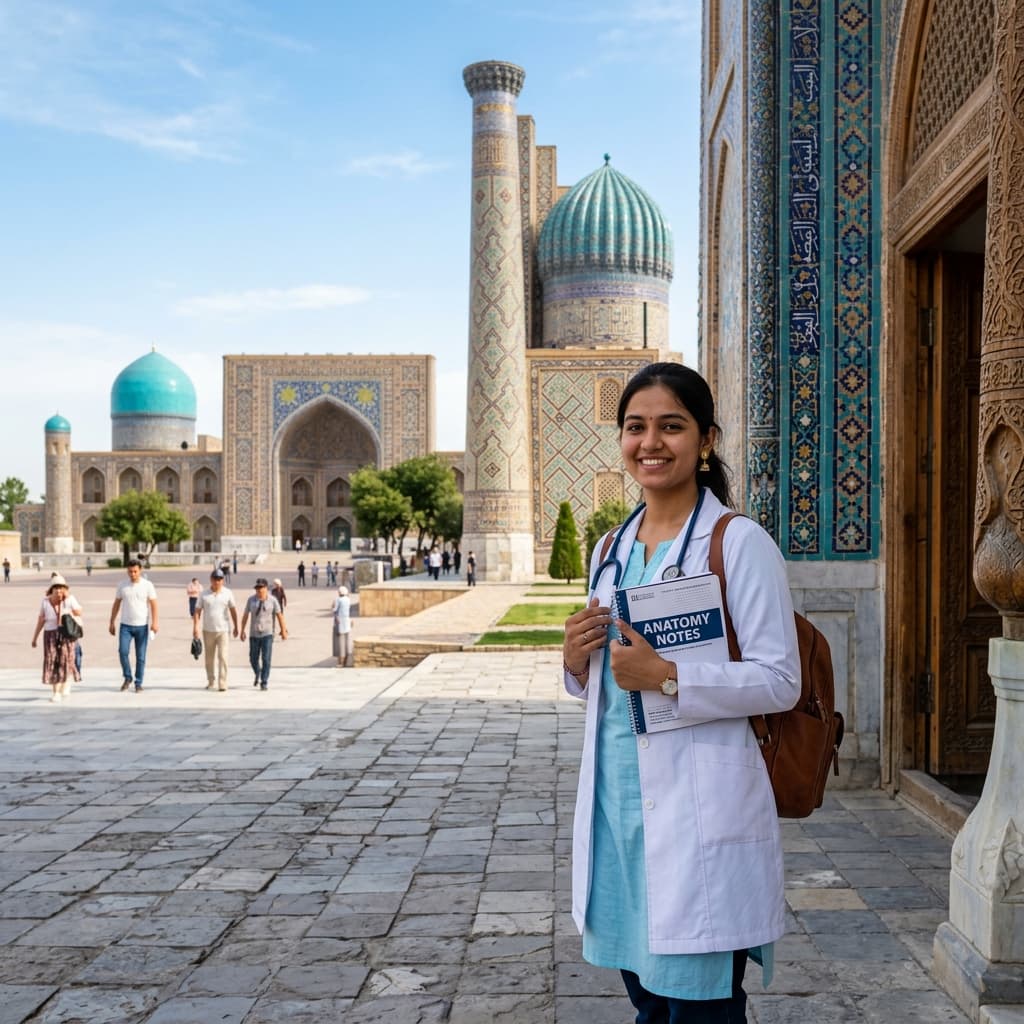
Uzbekistan is home to some of the most spectacular Islamic architecture in the world — the Registan in Samarkand, the Old City of Bukhara, the walled city of Khiva. Students who enjoy history, culture, and travel will find Uzbekistan endlessly fascinating.
Duration of MBBS in Uzbekistan
Medical programs in Uzbekistan follow a 6-year MD structure similar to Russia and other post-Soviet states:
- Year 1–2: Preclinical sciences (Anatomy, Physiology, Biochemistry, Biophysics, Histology)
- Year 3–4: Para-clinical subjects (Pathology, Pharmacology, Microbiology, Community Medicine)
- Year 5–6: Full clinical rotations across all major specialties
The degree awarded is MD (General Medicine), equivalent to MBBS. After clearing FMGE, Indian graduates can register with NMC and practice medicine in India.
Top NMC-Approved Universities for MBBS in Uzbekistan (2026)
1. Andijan State Medical Institute (ASMI)
Location: Andijan (Fergana Valley, eastern Uzbekistan) Annual Fees: Approximately ₹3–4.5 lakhs Established: 1955 Medium: English and Russian programs available
Andijan State Medical Institute is one of the oldest and most prestigious medical institutions in Uzbekistan. Established in 1955, ASMI has decades of experience in training medical professionals and has a well-developed academic infrastructure — lecture halls, anatomy dissection labs, histology and microbiology departments, and affiliated teaching hospitals in Andijan City.
Andijan is located in the fertile Fergana Valley in eastern Uzbekistan, bordering Kyrgyzstan. The city has a moderate climate — warmer than Bishkek and Tashkent — and a predominantly Uzbek cultural environment. The cost of living in Andijan is lower than in Uzbekistan's capital, Tashkent, making it particularly attractive for budget-conscious students.
ASMI's teaching hospitals handle a large volume of patients from the Fergana Valley region, which provides students with extensive and diverse clinical exposure. Indian students at ASMI report a positive academic environment and a supportive administration.
2. Bukhara State Medical Institute named after Abu Ali Ibn Sino
Location: Bukhara Annual Fees: Approximately ₹2.5–4 lakhs Established: 1990 Medium: English-medium program available
Named after Abu Ali Ibn Sina (Avicenna) — the 11th-century Persian polymath and father of early modern medicine who was born in the region — Bukhara State Medical Institute carries a name with extraordinary historical significance in the history of medicine.
The institute is located in Bukhara, one of the most historically significant cities in the Islamic world and a UNESCO World Heritage Site. The city is safe, beautiful, and has a very low cost of living — making Bukhara State Medical Institute one of the most affordable and culturally rewarding MBBS options available anywhere in the world.
The institute offers a complete English-medium MD program and has been building its international student intake steadily. Clinical training is conducted at major hospitals in Bukhara, and the faculty includes experienced Uzbek medical specialists. The institute's administration has been making significant investments in modernising its facilities and international student support systems.
3. Central Asian University Medical School
Location: Tashkent Annual Fees: Approximately ₹4–5.5 lakhs Established: 2000 (CAU); Medical School more recently Medium: English
Central Asian University (CAU) is a modern private university in Tashkent — the capital and largest city of Uzbekistan. CAU is part of the Aga Khan Development Network, which brings international standards and resources to higher education in Central Asia. The Medical School at CAU is the most modern and internationally connected of the Uzbek institutions, offering a program aligned with global medical education best practices.
Tashkent is the most developed and cosmopolitan city in Uzbekistan — a city of wide boulevards, modern infrastructure, international restaurants, and a vibrant student life. For students who want the comfort and amenities of a major city alongside their medical education, Tashkent and CAU Medical School offer the best combination.
CAU's affiliation with the Aga Khan network also provides students with access to a global network of healthcare institutions, which can be beneficial for clinical electives, research opportunities, and international career development.
Fees and Total Cost of Studying MBBS in Uzbekistan
| Expense | Annual Cost (Approx.) |
|---|---|
| Tuition Fees | ₹2.5 – 5.5 lakhs |
| Hostel / Accommodation | ₹50,000 – 1.2 lakhs |
| Food & Groceries | ₹40,000 – 80,000 |
| Travel (India–Uzbekistan, annual) | ₹35,000 – 60,000 |
| Health Insurance | ₹15,000 – 25,000 |
| Books & Miscellaneous | ₹15,000 – 30,000 |
| Total per year | ₹3.55 – 8 lakhs |
Total 6-year cost: approximately ₹21 – 48 lakhs — one of the lowest total costs among all NMC-approved MBBS destinations.
Uzbekistan's currency is the Uzbekistani Som (UZS). Everyday expenses — local food, transport, utilities — are significantly cheaper than in India, giving Indian students good purchasing power.
Eligibility Criteria for MBBS in Uzbekistan 2026
Academic Requirements
- Completion of Class 12 (10+2) with Physics, Chemistry, and Biology
- Minimum 50% aggregate in PCB subjects (40% for SC/ST/OBC as per NMC)
NEET Requirement
Mandatory. All Indian students must qualify NEET before enrolling in any foreign medical university. This is an absolute NMC requirement for FMGE eligibility.
Age
- Minimum 17 years at time of admission
- No upper age limit
Documents Required
- Class 10 and 12 mark sheets and certificates
- Valid Indian passport
- NEET admit card and scorecard
- Medical fitness certificate
- HIV test certificate (negative)
- Passport-size photographs
- Birth certificate
Admission Process for MBBS in Uzbekistan 2026
Step 1: Apply to Your Chosen University
Submit your application with academic documents. Uzbek universities process international applications quickly — within 1–3 weeks in most cases.
Step 2: Receive Admission/Invitation Letter
The university issues a formal admission letter after reviewing your application. This is required for the visa process.
Step 3: Apply for Uzbekistan Student Visa
Indian students require a student visa for Uzbekistan. The process can be initiated through the Uzbek Embassy in New Delhi. Required documents:
- Valid passport
- Admission/invitation letter from the university
- Completed visa application form
- Proof of fee payment
- Bank statement
- Medical insurance
- Photographs
Processing time: approximately 2–4 weeks. Uzbekistan has also introduced an e-visa system — check the current status as regulations continue to evolve.
Step 4: Travel to Uzbekistan
Fly to Tashkent International Airport (Islam Karimov International Airport) for universities in Tashkent or connecting onwards to Andijan or Bukhara. Uzbekistan Airways and other carriers offer one-stop connections from major Indian cities via Dubai, Doha, or Moscow.
Step 5: Enrol and Begin Studies
Complete enrollment formalities, pay fees, register for accommodation, and attend orientation. The academic year typically begins in September.
Life as an Indian Student in Uzbekistan
Climate
Uzbekistan has a continental desert climate — very hot summers (up to 40°C) and cold winters (as low as -10°C in Tashkent, milder in Andijan and Bukhara). The climate is dry, with very little rainfall. Indian students from arid and semi-arid regions of India find the climate relatively familiar. The extreme summer heat is the main challenge.
Food
Uzbek cuisine is Central Asian and heavily meat-based — plov (rice and lamb), samsa (meat pastries), shashlik (skewers), and lagman (noodle soup). Vegetarian options are available but require some searching. Indian grocery stores are available in Tashkent and growing in Andijan and Bukhara. Most Indian students cook their own food, and Indian spices are accessible.
Safety
Uzbekistan is one of the safest countries in Central Asia. The crime rate is very low and the country has a strong law enforcement presence. Indian students consistently report feeling safe in Uzbekistan's cities.
Cultural Richness
Studying in Uzbekistan is a unique cultural experience. The ancient cities of Samarkand, Bukhara, and Khiva — accessible by fast train — are among the most beautiful in the world. For students with an interest in history, Islamic art and architecture, and the Silk Road, Uzbekistan offers experiences unavailable anywhere else.
Indian Community
The Indian student community in Uzbekistan is growing, particularly in Andijan and Tashkent. Indian student associations are active and organise cultural events. The Fergana Valley region (where Andijan is located) has a cultural and culinary familiarity that many Indian students find comfortable.
FMGE Preparation for Uzbekistan Graduates
Uzbek medical universities follow a curriculum derived from the Soviet-era Russian medical education system, updated with modern content. Like Russia, the curriculum is comprehensive but requires deliberate supplementation with Indian-standard materials for FMGE success.
Key Recommendations
- Textbook alignment from Year 1: Use BD Chaurasia (Anatomy), AK Jain (Physiology), KD Tripathi (Pharmacology), Park's (Community Medicine), Harsh Mohan (Pathology), Ananthanarayan (Microbiology) alongside your university textbooks
- Community Medicine is critical: Park's Textbook covers the specific Indian public health context tested in FMGE — do not rely on the university's SPM curriculum alone
- Clinical subjects: For Medicine, Surgery, OBG, and Paediatrics, use the same Indian references used by MBBS students in India (Harrison's for reference, Davidson's for exam focus)
- Online preparation: Marrow and PrepLadder FMG programs are valuable for structured, topic-by-topic FMGE preparation alongside your university curriculum
- Mock tests: Attempt full-length FMGE mock tests from Year 4 onwards to build exam stamina and identify weak areas
Frequently Asked Questions
Q: Is MBBS from Uzbekistan valid in India? Yes. Degrees from NMC-approved Uzbek universities (listed in WDOMS) are valid in India upon clearing the FMGE.
Q: Is Uzbekistan better than Kyrgyzstan for MBBS? Both are affordable Central Asian options with NMC-approved universities. Uzbekistan has richer cultural heritage and a more developed capital (Tashkent). Kyrgyzstan, particularly Bishkek, has a slightly more established Indian student ecosystem. Both are strong options at similar price points.
Q: Is NEET mandatory for MBBS in Uzbekistan? Yes. NMC requires all Indian students to have qualified NEET before enrolling in any foreign medical university.
Q: Are there direct flights from India to Uzbekistan? Yes. IndiGo and Air Arabia operate flights connecting India to Tashkent. Uzbekistan Airways also flies between Tashkent and Delhi with occasional direct services. Total travel time is approximately 4–6 hours.
Q: What language is used for teaching in Uzbekistan? English-medium programs are available at all three universities listed above. Basic Uzbek and Russian language courses are part of the curriculum to facilitate patient communication.
Q: What is the currency of Uzbekistan? The Uzbekistani Som (UZS). Living costs are very affordable — comparable to or lower than Kyrgyzstan.
Conclusion
Uzbekistan in 2026 is an under-the-radar gem among MBBS-abroad destinations — offering NMC-recognised degrees, very affordable fees, a safe environment, and a uniquely rich cultural experience in one of history's most storied regions.
For Indian students who want a quality medical education at the lowest possible cost, Andijan State Medical Institute, Bukhara State Medical Institute, and Central Asian University Medical School are all strong choices with different characteristics — from the most affordable (Bukhara) to the most internationally connected (CAU Tashkent).
Students Traffic counsellors can help you compare these universities in detail, understand the visa process, and make the decision that is right for your profile and budget. Our guidance is completely free — reach out today.