MBBS in Georgia 2026: Top Universities, Fees & Admission Guide for Indian Students
Georgia — the small but rapidly developing country nestled between the Caucasus Mountains and the Black Sea — has emerged as one of the most sought-after destinations for Indian students pursuing MBBS abroad. With NMC-approved universities, a European-standard curriculum, English-medium instruction, and a warm, welcoming culture, Georgia ticks many of the right boxes for Indian medical aspirants in 2026.
This guide covers everything you need to know about studying MBBS in Georgia — from the top universities and their fees to eligibility criteria, the admission process, life as an Indian student, and how to approach FMGE preparation.
Why Georgia Is Gaining Popularity Among Indian Medical Students
Georgia was not always on the radar for Indian students. But over the last decade, it has seen a dramatic rise in international medical students — particularly from India, the Middle East, and other parts of South Asia. Here is why:
1. European-Standard Medical Education
Georgia is a member of the Bologna Process, the European Higher Education Area framework that standardises degree structures across Europe. This means Georgian medical degrees follow the same 6-year MD (Doctor of Medicine) structure as European universities. Graduates are eligible to practice across the European Union (after passing the respective national licensing exams) and can appear for USMLE, PLAB, and FMGE.
2. NMC Recognition
Several Georgian medical universities are listed in the World Directory of Medical Schools (WDOMS) and are recognised by the National Medical Commission (NMC) of India. Indian students graduating from these universities are eligible to appear for the FMGE/NMC Screening Test and obtain a medical license in India.
3. Fully English-Medium Programs
All major Georgian medical universities offer their MBBS/MD programs entirely in English. There is no Georgian language requirement for academic coursework, though basic Georgian is helpful for day-to-day life.
4. Affordable Fees With European Quality
Annual tuition fees at Georgian medical universities range from approximately ₹4.5 to ₹8 lakhs — making Georgia comparable to or slightly more expensive than Russia but significantly cheaper than European universities. The overall cost of living in Georgia is among the lowest in Europe.
5. Safe, Beautiful Country With Good Infrastructure
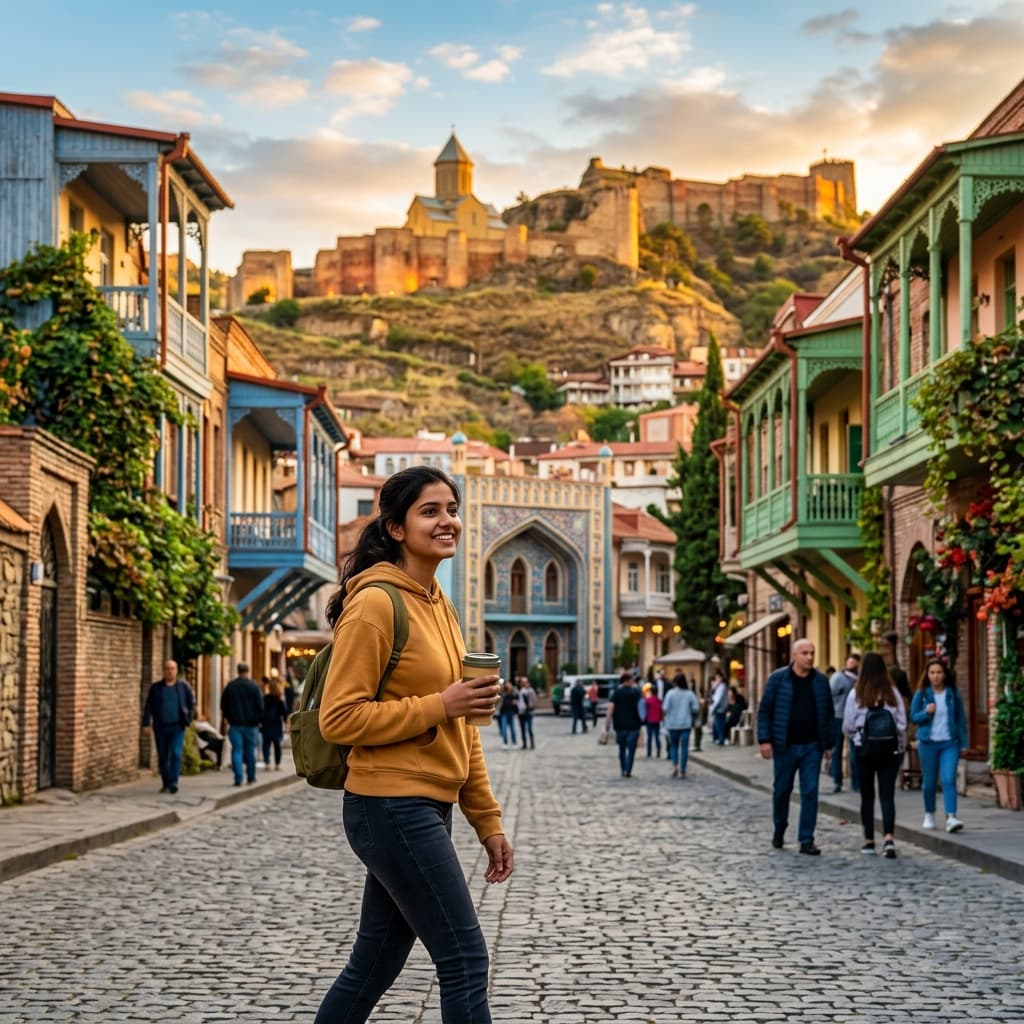
Georgia is a remarkably safe country with a low crime rate. Tbilisi, the capital, is a modern, cosmopolitan city with a rich culture, excellent restaurants, and good public transport. Batumi, on the Black Sea coast, is a resort city with a vibrant lifestyle. Both cities are popular among Indian students.
6. Ease of Travel and Visa
India and Georgia have a simplified visa arrangement. Indian students can obtain a Georgian student visa without the complex bureaucracy associated with countries like Russia or China. Georgia also has direct and connecting flights from major Indian cities.
Duration of MBBS in Georgia
The medical program in Georgia follows the European 6-year MD structure:
- Year 1–2: Preclinical sciences (Anatomy, Physiology, Biochemistry, Histology, Microbiology)
- Year 3–4: Para-clinical and early clinical subjects (Pathology, Pharmacology, internal medicine fundamentals)
- Year 5–6: Full clinical rotations in affiliated teaching hospitals
After completing the 6-year program, students are awarded an MD (Doctor of Medicine) degree, which is equivalent to MBBS in India.
Top NMC-Approved Universities for MBBS in Georgia (2026)
The following universities in Georgia are recognised by the NMC and are actively enrolling Indian students:
1. Alte University
Location: Tbilisi Annual Tuition: Approximately ₹5–7 lakhs Medium: English
Alte University is one of the newer but rapidly growing private universities in Georgia, offering a modern MD program aligned with European medical education standards. The university has invested heavily in infrastructure — modern simulation labs, anatomy dissection halls, and a well-equipped teaching hospital network. Alte University actively recruits international students and has a growing Indian student community in Tbilisi.
The academic approach at Alte emphasises problem-based and case-based learning, which prepares students well for international licensing exams including FMGE and USMLE. The faculty includes international professors alongside Georgian clinical specialists.
2. BAU International University, Batumi
Location: Batumi (Black Sea coast) Annual Tuition: Approximately ₹5–7 lakhs Medium: English Parent Institution: Bahçeşehir University (Turkey — a major European university group)
BAU International University Batumi is part of the prestigious BAU Global network headquartered in Turkey, with campuses across Europe, the USA, and Asia. This institutional backing gives the Batumi campus access to high-quality academic resources, faculty exchange programs, and a truly international learning environment.
Batumi itself is one of the most attractive cities for student life in the Caucasus region — a modern Black Sea resort city with a Mediterranean climate (milder than Tbilisi), beautiful beaches, and a vibrant social scene. Indian students at BAU Batumi benefit from a supportive international student office and structured clinical rotations across Adjara region hospitals.
3. Caucasus International University (CIU)
Location: Tbilisi Annual Tuition: Approximately ₹4.5–6 lakhs Medium: English Established: 1995
Caucasus International University is one of the older and more established private universities in Georgia. CIU has been enrolling international students — including a significant number from India — for many years and has built strong support systems for foreign students. The university offers a comprehensive English-medium MD program taught by experienced Georgian and international faculty.
CIU's clinical training is conducted in partnership with major Tbilisi hospitals, giving students access to a diverse patient caseload. The university has a well-functioning Indian student association and organises cultural events, mentoring programs, and academic support for students from India.
4. East European University (EEU)
Location: Tbilisi Annual Tuition: Approximately ₹4.5–6 lakhs Medium: English
East European University is a well-regarded private institution in Tbilisi offering an internationally accredited MD program. EEU has been awarded quality accreditation by international bodies and is listed in the WDOMS. The university's faculty is a mix of Georgian medical specialists and visiting international professors.
EEU is known for maintaining a manageable class size, which allows for more personalised instruction and direct faculty interaction — an advantage during the preclinical years when building strong foundational knowledge is critical for future FMGE success.
5. Georgian National University SEU
Location: Tbilisi Annual Tuition: Approximately ₹5–7 lakhs Medium: English Established: 2012
Georgian National University SEU (Smart Education University) is one of the fastest-growing medical universities in Georgia. SEU has invested heavily in modern infrastructure and has built a reputation for quality medical education among international students. The university's campus is modern, well-equipped, and located in Tbilisi.
SEU emphasises simulation-based training and early clinical exposure, which is especially valuable for students preparing for the FMGE, where clinical application of knowledge is heavily tested. The university's international relations team provides dedicated support for Indian students throughout their enrollment.
Fees and Total Cost of MBBS in Georgia
Here is a comprehensive breakdown of all costs involved in pursuing MBBS in Georgia:
| Expense | Annual Cost (Approx.) |
|---|---|
| Tuition Fees | ₹4.5 – 7 lakhs |
| Hostel / Accommodation | ₹1 – 2 lakhs |
| Food & Groceries | ₹80,000 – 1.2 lakhs |
| Travel (India–Georgia, annual) | ₹40,000 – 70,000 |
| Health Insurance | ₹20,000 – 40,000 |
| Books & Stationery | ₹15,000 – 30,000 |
| Miscellaneous | ₹25,000 – 50,000 |
| Total per year | ₹7 – 12 lakhs |
Total 6-year cost: approximately ₹42 – 72 lakhs.
This is comparable to Russia and significantly cheaper than private medical colleges in India or MBBS in Western Europe. Georgia's relatively low cost of living — groceries, transport, and eating out are all significantly cheaper than in India's major metros — helps keep the overall expenses manageable.
Eligibility Criteria for MBBS in Georgia 2026
Academic Requirements
- Completion of Class 12 (10+2) with Physics, Chemistry, and Biology
- Minimum 50% aggregate in PCB subjects (40% for SC/ST/OBC as per NMC norms)
NEET Requirement
Mandatory. Indian students must have qualified NEET before enrolling in any foreign medical university. This is a non-negotiable NMC requirement for eligibility to appear for FMGE and register with NMC after completing MBBS abroad.
Age
- Minimum 17 years at the time of admission
- No upper age limit
Documents Required
- Class 10 and 12 mark sheets and certificates
- Valid Indian passport (recommended minimum 2 years validity)
- NEET admit card and scorecard
- Medical fitness certificate
- HIV test certificate (negative)
- Passport-size photographs
- Birth certificate
Admission Process for MBBS in Georgia 2026
The admission cycle for Georgian universities typically runs from April to August for September intake. Some universities also have a February intake.
Step 1: Research and Apply
Shortlist NMC-approved Georgian universities based on fees, location (Tbilisi vs. Batumi), and student reviews. Submit your application with required documents.
Step 2: Receive Admission Offer Letter
The university issues a formal admission/acceptance letter after reviewing your application. This is typically a quick process for Georgian universities — often within 1–2 weeks of application submission.
Step 3: Apply for Georgia Student Visa
Indian students require a D-category (student) visa for Georgia. Required documents:
- Valid passport
- Admission/acceptance letter from the Georgian university
- Completed visa application form
- Proof of tuition fee payment (partial or full)
- Bank statement showing sufficient funds
- Medical insurance
- Passport-size photographs
Georgia has a Georgian Embassy in New Delhi. Processing time is typically 2–4 weeks.
Step 4: Travel and Enrol
Fly to Tbilisi (Shota Rustaveli Tbilisi International Airport) or Batumi (Batumi International Airport). Both cities have direct or one-stop connections from major Indian cities. Complete enrollment formalities, pay fees, register for accommodation, and attend orientation.
Step 5: Academic Program Begins
Most Georgian universities begin the academic year in September–October. The first year is typically the most intensive in terms of foundational science subjects.
Life as an Indian Student in Georgia
Climate
Georgia has a temperate climate — warmer and more pleasant than Russia and most of Eastern Europe. Tbilisi sees mild winters (rarely below -5°C) and hot summers. Batumi, on the Black Sea coast, has a humid subtropical climate — warm year-round with significant rainfall. Indian students generally find the Georgian climate comfortable.
Food
Georgian cuisine is diverse, flavourful, and vegetarian-friendly. Khachapuri (cheese bread), khinkali (dumplings), and a variety of vegetable stews are staples. Indian grocery stores and restaurants are available in Tbilisi and are growing in Batumi. Most students cook Indian food in their hostel kitchens and shop for Indian spices and lentils at local Asian grocery stores.
Safety
Georgia is one of the safest countries in the region. The crime rate is very low and Georgian people are known for their warmth and hospitality to foreigners. Indian students consistently report feeling safe and welcome.
Cultural Life
Georgia has a rich cultural heritage — ancient monasteries, vibrant festivals, stunning mountain scenery, and a legendary wine culture (Georgia is one of the world's oldest wine-producing regions). For Indian students who enjoy travel and cultural exploration, Georgia is an exceptionally rewarding place to spend 6 years.
Indian Community
The Indian student community in Georgia is growing rapidly. Major universities in Tbilisi and Batumi have active Indian student associations. Cultural events for Diwali, Holi, and Independence Day are organised by student groups. Senior students are generally very supportive of juniors and provide invaluable guidance on academic preparation, FMGE strategy, and navigating life in Georgia.
FMGE Preparation for Georgian Medical Graduates
Georgian universities follow a European curriculum structure, which is rigorous but differs from the Indian medical education system in some respects. Strategic FMGE preparation is essential.
Key Points
- Start from Year 1: Use Indian standard textbooks (BD Chaurasia, AK Jain, KD Tripathi, Park's) alongside your university curriculum from day one
- Pathology and Pharmacology are particularly critical — invest heavily in Harsh Mohan/Robbins and KD Tripathi
- Community Medicine (SPM) — Park's Textbook is mandatory; this subject is heavily tested in FMGE
- Subscribe to online FMGE platforms like Marrow or PrepLadder from Year 2 onwards
- Form Indian FMGE study groups with batchmates — collaborative studying significantly improves retention and coverage
Georgian graduates who prepare systematically alongside their university curriculum from early years consistently achieve good FMGE results.
Frequently Asked Questions
Q: Is MBBS from Georgia valid in India? Yes. Degrees from NMC-approved Georgian universities are valid in India upon clearing the FMGE/NMC Screening Test.
Q: Is Georgia better than Russia for MBBS? Both are excellent destinations. Georgia offers a more European curriculum, better climate, and easier travel logistics. Russia offers a greater number of NMC-approved universities and a longer established track record. The best choice depends on your specific university preferences and budget.
Q: Is NEET mandatory for MBBS in Georgia? Yes. NMC mandates NEET qualification for all Indian students seeking to enrol in foreign medical universities.
Q: Can I work part-time in Georgia as a student? Georgian student visa regulations permit limited part-time work. However, most medical students find the academic workload leaves little time for employment.
Q: What is the weather like in Georgia? Georgia has a temperate climate. Tbilisi has mild winters and warm summers. Batumi has a subtropical climate — warmer and wetter. Both are significantly more comfortable than Russia's winters.
Q: Are there direct flights from India to Georgia? There are no direct flights between India and Georgia currently. Most students fly via Dubai, Istanbul, Doha, or Moscow. Total travel time is approximately 6–10 hours depending on the connection.
Conclusion
Georgia in 2026 represents one of the best value-for-money destinations for MBBS abroad — combining European academic standards, NMC recognition, English-medium instruction, an affordable cost of living, and a safe, welcoming environment.
The universities listed on Students Traffic — Alte University, BAU International University Batumi, Caucasus International University, East European University, and Georgian National University SEU — are all reputable institutions with dedicated support for Indian students.
If you want personalised guidance on choosing the right Georgian university for your profile and budget, our counsellors at Students Traffic are ready to help. The counselling is completely free.