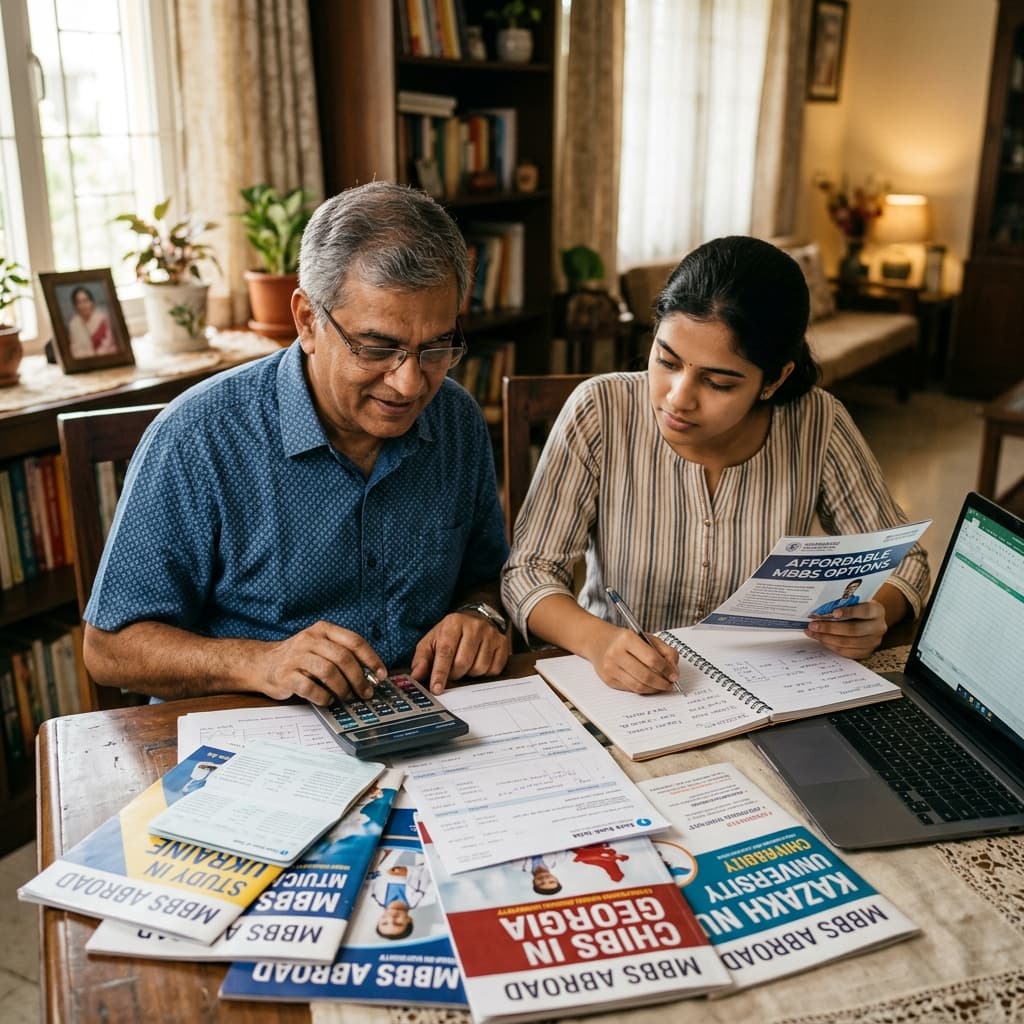
Why MBBS Fee Comparisons Are Usually Wrong
Search "MBBS abroad fees" and you will find tuition figures ranging from ₹12 lakh to ₹55 lakh for a 6-year program. Almost all of them are incomplete.
Consultancies and university marketing materials advertise tuition fees because those are the lowest number in the cost structure. Hostel, food, visa, flights, insurance, and post-graduation exam coaching are rarely included — but they are real, recurring, and collectively often exceed tuition itself.
This guide gives you the honest total cost of MBBS in each major destination country for Indian students — based on verified fee disclosures, student-reported data, and publicly available university sources as of 2026.
Use this as a starting point. Verify specific university fees directly before committing.
Methodology and Currency Note
All figures are presented in Indian Rupees (₹). USD-denominated costs are converted at approximately ₹84 = $1 (March 2026 rate). Currency movements over 6 years will affect actual costs; budget for a 10–15% currency risk buffer on USD-denominated programs.
Living costs reflect mid-range estimates based on student-reported data from university forums and Students Traffic peer community. Costs vary by city and lifestyle.
Russia
Russia offers the widest range of NMC-recognized universities of any single country — over 50 universities, spanning very different price points and quality tiers.
Tuition Fees (Annual, 2026)
| University Tier | Annual Tuition (USD) | Annual Tuition (₹) |
|---|---|---|
| Tier 1 (Sechenov, RUDN, Kazan Federal) | $7,000–$9,000 | ₹5.9–7.6L |
| Tier 2 (Regional state universities) | $4,500–$6,500 | ₹3.8–5.5L |
| Tier 3 (Smaller private/regional) | $2,800–$4,500 | ₹2.4–3.8L |
Living Costs (Annual)
| Cost Component | Moscow/SPB | Regional cities |
|---|---|---|
| Hostel (university) | ₹1.8–2.4L | ₹60,000–1.2L |
| Food | ₹1.5–2.0L | ₹1.0–1.5L |
| Transport | ₹30,000–50,000 | ₹15,000–30,000 |
| Personal expenses | ₹60,000–1.2L | ₹40,000–80,000 |
Total Cost (6 Years, 2026) by Tier
| Tier | Tuition (6Y) | Living (6Y) | Flights (6) | Visa | Total |
|---|---|---|---|---|---|
| Tier 1 (Moscow/SPB) | ₹35–46L | ₹25–32L | ₹3L | ₹60K | ₹64–82L |
| Tier 2 (Mid-tier state) | ₹23–33L | ₹16–22L | ₹3L | ₹60K | ₹43–59L |
| Tier 3 (Low-cost) | ₹14–23L | ₹12–18L | ₹3L | ₹60K | ₹30–44L |
Post-graduation (NExT coaching): add ₹2–4L
What the Numbers Mean
Russia's Tier 3 universities are genuinely affordable at ₹30–44L total. However, FMGE pass rates at bottom-tier Russian universities have historically been below 15%. The cost saving at enrollment can translate to a multi-year delay in practice start if NExT preparation is harder from a weaker clinical base.
Tier 2 universities in cities like Kazan, Saratov, and Perm represent the value zone — reasonable fees, NMC-recognized, and reasonable FMGE outcomes.
Geopolitical risk note: Post-2022 developments have affected banking (international transfers) and logistics (flight routes) for Russia. Most universities continue to receive students and payment. However, students should account for potential currency conversion difficulties and plan bank arrangements in advance.
Kazakhstan
Kazakhstan has absorbed a significant portion of the Indian student flow that previously went exclusively to Russia. Several NMC-recognized universities here have strong track records.
Tuition Fees (Annual, 2026)
| University | Annual Tuition (USD) | Annual Tuition (₹) |
|---|---|---|
| Kazakh National Medical University (KazNMU), Almaty | $5,000–$6,500 | ₹4.2–5.5L |
| Astana Medical University (Nur-Sultan) | $4,500–$6,000 | ₹3.8–5.0L |
| South Kazakhstan Medical Academy | $3,500–$5,000 | ₹2.9–4.2L |
| Other regional universities | $2,800–$4,500 | ₹2.4–3.8L |
Living Costs (Annual)
| Cost Component | Almaty | Nur-Sultan |
|---|---|---|
| Hostel (university) | ₹80,000–1.4L | ₹1.0–1.6L |
| Food | ₹1.2–1.8L | ₹1.2–1.8L |
| Winter clothing (one-time) | ₹30,000–60,000 | ₹40,000–80,000 |
| Transport | ₹20,000–40,000 | ₹25,000–45,000 |
Nur-Sultan warning: The capital experiences temperatures of −20°C to −30°C during winter months. This is not an advisory note — it is a daily life reality. Many students from warmer Indian states struggle significantly.
Total Cost (6 Years) — KazNMU Almaty
| Component | Cost |
|---|---|
| Tuition (6Y × ₹5L avg) | ₹30,00,000 |
| Hostel (6Y × ₹1.1L) | ₹6,60,000 |
| Food (6Y × ₹1.5L) | ₹9,00,000 |
| Personal expenses (6Y × ₹60K) | ₹3,60,000 |
| Flights (6 round trips) | ₹3,00,000 |
| Visa and extensions | ₹60,000 |
| Winter outfitting (one-time) | ₹50,000 |
| Medical insurance | ₹1,20,000 |
| Total | ₹54,50,000 |
Post-graduation NExT coaching: add ₹2–4L
Kazakhstan advantage over Russia: Relatively stable geopolitical position, improved banking access, growing Indian student community with established support infrastructure.
Philippines
The Philippines is distinctive in structure. Students typically complete a 4-year BS degree (Biology or a Health Science equivalent) before entering a 4-year MD program — making the total timeline 8 years instead of 6. Some universities offer an integrated 5.5-year program. This structural difference has major cost and career implications.
Understanding the BS+MD Model
Year 1–4: BS Biology/Health Sciences (~$2,500–3,500/year)
Year 5–8: MD ($4,000–6,000/year at top universities)
The BS years are less expensive, but the additional 2 years compared to other countries add 2 years of living costs and delay career start.
Tuition Fees (Annual, 2026)
| University | BS/yr (USD) | MD/yr (USD) | Combined ₹ |
|---|---|---|---|
| University of Santo Tomas (UST) | $3,200 | $5,500 | ₹52–58L (8Y) |
| Our Lady of Fatima University | $2,800 | $4,800 | ₹46–52L (8Y) |
| AMA School of Medicine | $2,500 | $4,500 | ₹42–48L (8Y) |
| De La Salle Medical & Health Sciences | $3,000 | $5,200 | ₹50–55L (8Y) |
Living Costs (Annual, Metro Manila / Laguna)
| Component | Annual |
|---|---|
| Accommodation (shared housing) | ₹1.2–2.0L |
| Food | ₹1.5–2.0L |
| Transport | ₹30,000–60,000 |
| Personal | ₹50,000–1.0L |
Total Cost (8 Years) — UST
| Component | Cost |
|---|---|
| BS Tuition (4Y × ₹2.7L) | ₹10,80,000 |
| MD Tuition (4Y × ₹4.6L) | ₹18,40,000 |
| Living (8Y × ₹4L/yr) | ₹32,00,000 |
| Flights (8 round trips) | ₹4,00,000 |
| Visa and extensions | ₹80,000 |
| Total | ₹66,00,000 |
Post-graduation NExT coaching: add ₹2–4L
Philippines advantage: Strongest English medium in any MBBS abroad destination. No language barrier. Philippine teaching hospitals (e.g., UST Hospital) are well-equipped. UST historically produces among the best FMGE pass rates.
Key consideration: The 8-year timeline (vs 6 years) is a significant factor. Two extra years of study abroad means two extra years of income delay and living costs. This is why comparable total costs to Russia or Kazakhstan can be higher despite similar annual fees.
Georgia
Georgia has positioned itself as the European-curriculum option at relatively accessible costs. The country is safe, culturally welcoming, and Tbilisi is a liveable city with growing Indian student communities.
Tuition Fees (Annual, 2026)
| University | Annual Tuition (USD) | Annual Tuition (₹) |
|---|---|---|
| Tbilisi State Medical University | $6,000–$7,000 | ₹5.0–5.9L |
| David Tvildiani Medical University (DTMU) | $5,500–$7,000 | ₹4.6–5.9L |
| New Vision University | $6,000–$8,000 | ₹5.0–6.7L |
| Caucasus International University | $4,500–$6,000 | ₹3.8–5.0L |
Living Costs (Annual, Tbilisi)
| Component | Annual |
|---|---|
| Accommodation (university dorm) | ₹80,000–1.4L |
| Food | ₹1.2–1.8L |
| Transport | ₹20,000–40,000 |
| Personal | ₹40,000–80,000 |
Total Cost (6 Years) — Mid-tier Georgia University
| Component | Cost |
|---|---|
| Tuition (6Y × ₹5L) | ₹30,00,000 |
| Hostel (6Y × ₹1.1L) | ₹6,60,000 |
| Food (6Y × ₹1.5L) | ₹9,00,000 |
| Personal (6Y × ₹60K) | ₹3,60,000 |
| Flights (6Y, fewer direct routes) | ₹4,00,000 |
| Visa costs | ₹60,000 |
| Total | ₹53,80,000 |
Post-graduation NExT coaching: add ₹2–4L
Georgia advantage: European curriculum (often European university partnerships for elective rotations), English medium, relatively safe and modern city. Several Georgian medical universities have recognition in multiple countries. Climate is mild.
Georgia consideration: Fewer direct flights from India (typically via Istanbul or Dubai) affects travel cost and convenience. Smaller Indian student networks mean less peer support than Russia or Kazakhstan.
Kyrgyzstan
Kyrgyzstan represents the lowest-cost MBBS abroad option with NMC-recognized universities. However, quality varies dramatically.
Tuition Fees (Annual, 2026)
| University | Annual Tuition (USD) | Annual Tuition (₹) |
|---|---|---|
| International School of Medicine (ISM) | $3,500–$4,500 | ₹2.9–3.8L |
| Osh State Medical University | $2,800–$4,000 | ₹2.4–3.4L |
| Jalal-Abad State Medical Academy | $2,500–$3,500 | ₹2.1–2.9L |
Total Cost (6 Years) — Mid-tier Kyrgyzstan
| Component | Cost |
|---|---|
| Tuition (6Y × ₹3L) | ₹18,00,000 |
| Hostel (6Y × ₹80K) | ₹4,80,000 |
| Food (6Y × ₹1.2L) | ₹7,20,000 |
| Personal (6Y × ₹50K) | ₹3,00,000 |
| Flights (6Y) | ₹3,00,000 |
| Visa | ₹40,000 |
| Total | ₹36,40,000 |
Post-graduation NExT coaching: add ₹2–4L
Critical note on Kyrgyzstan: The low tuition is real. The FMGE pass rate has historically been among the lowest of all countries. Some universities here have had NMC recognition issues. Always verify the specific university's current NMC status before enrolling — not just "Kyrgyzstan is NMC approved" but that specific university.
Students who choose Kyrgyzstan need to be disproportionately self-directed in NExT preparation throughout their 6 years, because the clinical training environment may not supplement exam readiness as effectively.
Bangladesh
Bangladesh MBBS is a unique case — it is geographically close to India, and the medical curriculum is similar to India's (both based on British medical tradition). The degree from recognized Bangladeshi universities is accepted by NMC without FMGE — it is treated equivalently to an Indian MBBS.
Tuition Fees (Annual, 2026)
| University Type | Annual Tuition (BDT) | Approx ₹ |
|---|---|---|
| Government medical colleges | Minimal (very competitive) | ₹25,000–50,000 |
| Private medical colleges (mid) | BDT 8–12L | ₹5.0–7.5L |
| Private medical colleges (high) | BDT 12–18L | ₹7.5–11L |
Key Difference: No FMGE Required
NMC recognizes MBBS degrees from Bangladesh's Medical and Dental Council-recognized universities directly. Graduates can apply for Indian State Medical Council registration without clearing NExT/FMGE as a separate exam.
This is a significant advantage over other countries, particularly given the challenging NExT/FMGE pass rates.
However: Admission to Bangladeshi private medical colleges is itself competitive for Indian students, and the total cost at premium private colleges can approach ₹55–70L over 5 years. Government colleges are essentially inaccessible to non-Bangladeshi students.
Bangladesh in context: For Indian students near the West Bengal/Northeast border or those who prefer a South Asian clinical environment, Bangladesh is worth serious consideration. The English language of instruction, FMGE exemption, and cultural familiarity are genuine advantages.
Vietnam
Vietnam offers the most affordable MBBS education among all popular destinations for Indian students, with total all-in costs for 6 years frequently under ₹40 lakh.
Tuition Fees (Annual, 2026)
| University | Annual Tuition (USD) | Annual Tuition (₹) |
|---|---|---|
| University of Medicine & Pharmacy HCMC (UMP-HCMC) | $3,500–$5,000 | ₹2.9–4.2L |
| Hanoi Medical University | $3,000–$4,500 | ₹2.5–3.8L |
| Hue University of Medicine and Pharmacy | $2,800–$4,000 | ₹2.4–3.4L |
Living Costs (Annual, Ho Chi Minh City / Hanoi)
| Component | Annual |
|---|---|
| Hostel/accommodation | ₹60,000–1.0L |
| Food (self-cooking + eating out) | ₹80,000–1.4L |
| Transport (excellent public transit) | ₹15,000–30,000 |
| Personal expenses | ₹30,000–60,000 |
Total Cost (6 Years) — UMP-HCMC
| Component | Cost |
|---|---|
| Tuition (6Y × ₹3.7L avg) | ₹22,20,000 |
| Hostel (6Y × ₹80K) | ₹4,80,000 |
| Food (6Y × ₹1.1L) | ₹6,60,000 |
| Personal (6Y × ₹45K) | ₹2,70,000 |
| Flights (6 round trips — affordable direct routes) | ₹2,40,000 |
| Visa and extensions | ₹40,000 |
| Total | ₹39,10,000 |
Post-graduation NExT coaching: add ₹2–4L
Vietnam's cost advantage is clear — at ₹39–45L all-in, it is the lowest-cost NMC-recognized MBBS abroad option available. The trade-off is a smaller established Indian student network and Vietnamese as the predominant language in clinical settings.
Key NMC note: Always verify each specific Vietnamese university against the current NMC approved list at nmc.org.in — only some universities in Vietnam are NMC-recognized. The number is growing, but not all institutions qualify.
Side-by-Side Comparison
| Country | Duration | Total Cost (₹) | Language | FMGE Required | Quality Tier |
|---|---|---|---|---|---|
| Russia (Tier 2 state univ.) | 6Y | ₹43–59L | English + Russian | Yes (NExT) | Medium–High |
| Russia (Tier 1 Moscow/SPB) | 6Y | ₹64–82L | English + Russian | Yes (NExT) | High |
| Kazakhstan (KazNMU) | 6Y | ₹50–58L | English | Yes (NExT) | Medium–High |
| Philippines (UST) | 8Y | ₹62–70L | English | Yes (NExT) | High |
| Georgia (mid-tier) | 6Y | ₹50–58L | English | Yes (NExT) | Medium–High |
| Kyrgyzstan (ISM) | 6Y | ₹33–40L | English + Kyrgyz | Yes (NExT) | Medium–Low |
| Vietnam (UMP-HCMC) | 6Y | ₹39–45L | English + Vietnamese | Yes (NExT) | Medium |
| Bangladesh (private) | 5Y | ₹40–65L | English | No | Medium |
Hidden Costs Rarely Included in Fee Quotes
1. Currency Fluctuation Risk
If the rupee weakens against the USD, your annual tuition in rupees increases. Over 6 years, a 10% rupee depreciation adds approximately ₹3–5L to a $5,000/year program.
2. NExT / FMGE Coaching
₹2–4L for a structured 6-month intensive coaching program after graduation is standard. Many students budget for this as a single expense. Factor it in from day 1.
3. Health Insurance
Many countries require mandatory student health insurance. Russia typically requires annual insurance (₹15,000–25,000/year through university). Philippines and Philippines: student health plans through the university.
4. Technology and Equipment
Medical equipment for lab practicals, laptops, books (Indian + university textbooks), stationery: budget ₹30,000–60,000 for Year 1, ₹15,000–25,000/year thereafter.
5. One-Time Setup Costs
Arriving in a new country involves setting up an apartment/hostel room, purchasing winter clothing (Russia, Kazakhstan), household essentials. Budget ₹30,000–80,000 as one-time setup.
6. Emergency Fund
Medical emergencies, family emergencies requiring quick return flights, or equipment replacement. Maintain ₹1–2L in accessible savings at all times.
How to Evaluate Affordability
A useful framework: Add total 6-year cost plus NExT coaching. Then consider:
Annual income as an Indian doctor (approximate):
- Fresher private hospital: ₹6–10L/year
- Government job (state): ₹10–15L/year
- After PG specialization: ₹20–60L/year depending on specialty
A ₹50L total MBBS cost, amortized over a career of 35 years, represents approximately ₹1.4L/year — less than one month's salary for a specialist. The financial calculus works if you practice medicine.
The risk scenario: students who do not clear NExT and do not practice. This risk is real. At a 20% national pass rate, 80% of foreign graduates either fail or take multiple attempts. The financial plan must account for this possibility: what happens if you need 2–3 NExT attempts over 2–3 years? The cost of delay (living expenses, coaching, opportunity cost) is real and should be modeled in your financial plan.
Financing MBBS Abroad
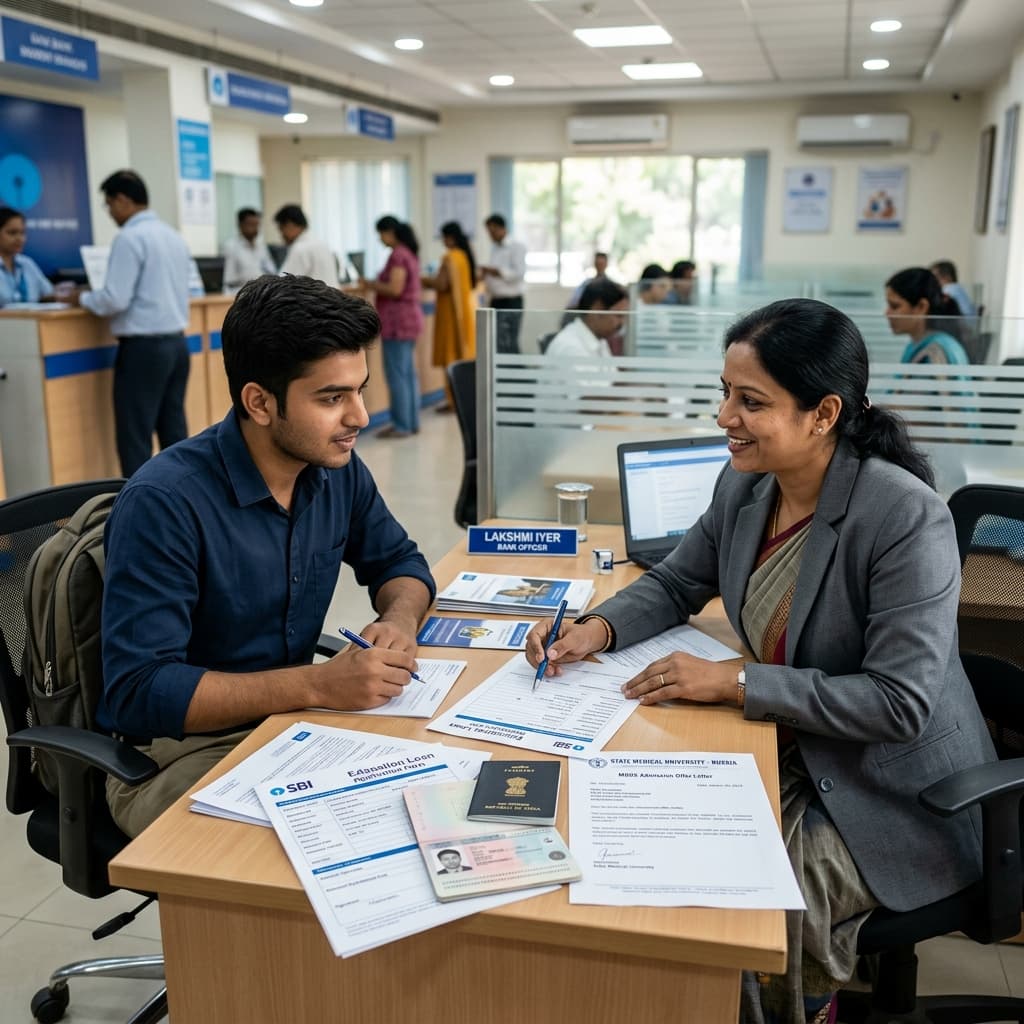
Education Loans
Most public sector banks offer education loans for MBBS abroad:
- SBI Scholar Loan / Global Ed-Vantage: Up to ₹1.5 crore; requires travel documents and admission letter from recognized university
- Bank of Baroda Baroda Vidya: Up to ₹80L abroad; collateral required above ₹10L
- Axis Bank, HDFC Credila: Private education loan providers; higher interest rates but more flexible processing
NMC recognition matters here too: Banks typically require the destination university to be NMC-recognized for education loan approval.
Scholarships
Scholarships for MBBS abroad are rare but exist:
- Government of India scholarship schemes for ASEAN countries
- Specific country government scholarships (Russian Government Scholarship — competitive, bilateral agreement quota)
- Indian government scholarship for Bangladesh (limited seats)
Most students self-finance through family savings and education loans.
Frequently Asked Questions
Which country has the lowest total cost for MBBS abroad? Kyrgyzstan has the lowest tuition, with total 6-year costs around ₹33–40L. However, lower costs correlate with lower NExT pass rates from those universities. Bangladesh represents a unique case — 5 years, FMGE exemption, but private college fees can be comparably high.
Is Russia MBBS still safe to invest in after 2022? Most Indian students continue successfully in Russia. Banking and logistics have additional friction but are not impossible. For new applicants in 2025, the situation is more stabilized than 2022. The risk is geopolitical uncertainty over a 6-year horizon — a risk that should be weighted according to your personal risk tolerance.
Can education loans cover all MBBS abroad costs? Education loans typically cover tuition, hostel, and a portion of living costs. Full living coverage is not always approved. Family contribution is typically needed for day-to-day expenses.
Are fees negotiable with universities abroad? Some universities offer early-bird admission discounts or loyalty scholarships. Group discounts (multiple students from the same family or school) are occasionally available. Negotiation is possible through direct university contact, not through agents who have their own commission interests.
What is the total cost of MBBS plus NExT prep versus MBBS in India? Private MBBS in India (management quota): ₹60–1.5 crore over 5.5 years, without scholarship. MBBS abroad at a mid-tier university: ₹45–60L over 6 years plus ₹3–4L NExT coaching. The cost argument for MBBS abroad is strongest against Indian private college fees — but the NExT requirement adds back significant preparation investment.
Making the Decision
Cost is important but should not be the only basis for choosing a country or university. The right framework:
- Confirm NMC recognition of the specific university (not just country-level)
- Verify FMGE/NExT outcome data from that university — ask Students Traffic peers who graduated from there
- Model total cost, not just tuition — use the full cost tables above
- Assess clinical training quality — talk to current students about hospital exposure and quality of teaching
- Consider personal fit — language, climate, cultural environment, support network availability
For transparent, peer-verified information on any specific university abroad, use the Students Traffic peer connect — the only space where you get an unsponsored opinion from someone already there.