The Philippines Question: Why It's Complicated
No destination in the MBBS abroad market has a more confusing regulatory history for Indian students than the Philippines. Here is the short version: the Philippines was once one of the top choices in the 1990s and early 2000s. Then MCI (now NMC) effectively barred the Philippines pathway for Indian students in 2009 by removing virtually all Philippine medical colleges from its approved list, citing concerns about the dual-stage BSc Biology + MD structure being non-equivalent to the Indian MBBS.
In subsequent years, NMC has reinstated a small number of Philippine medical institutions to its approved list. Today, the Philippines sits in a nuanced middle position: some specific colleges are NMC-recognized and Indian graduates can pursue NExT; some are not. The country simultaneously attracts Indian students targeting USMLE (US Medical Licensing Examination) over NExT — a completely different career pathway.
This guide separates the facts from the confusion.
How Medical Education in the Philippines Works
Understanding the structure is essential because it differs fundamentally from MBBS in India, Russia, or Central Asia.
The BS Biology + MD Pathway (Primary Model)
Unlike most countries where medical education is a single continuous program (MBBS in India = 5.5 years; MD in Russia = 6 years), the Philippines uses a two-stage system:
Stage 1: Bachelor of Science in Biology (BS Biology)
- Duration: 2 years (some accelerated versions for students with strong pre-med backgrounds)
- Content: Pre-medical sciences — Zoology, Botany, Chemistry, Physics, Biochemistry, Cell Biology
- Award: A bachelor's degree (BS Biology)
- This is a prerequisite for the MD program
Stage 2: Doctor of Medicine (MD)
- Duration: 4 years
- Content: Full medical curriculum — Anatomy, Physiology, Pathology, Pharmacology, all clinical sciences
- Award: Doctor of Medicine (MD) degree
- This MD is what NMC evaluates for equivalent to Indian MBBS
Total duration: 2 + 4 = 6 years (roughly equivalent in time to MBBS abroad programs in CIS countries, though the degree structure differs)
The Direct MD Pathway (Limited Availability)
Some Philippine universities offer a direct MD program to students who already hold a BSc or Pre-Med qualification — eliminating the 2-year BS Biology stage. This is relevant for Indian students who completed a BSc degree in India first (e.g., BSc Biology or BSc Chemistry) before applying. Duration in this scenario: 4 years MD only.
Critical structural point: NMC evaluates the Philippine MD degree for equivalence to Indian MBBS. The BS Biology stage is considered a pre-medical qualification, not part of the medical degree itself. This distinction caused the original NMC/MCI dispute — MCI argued the 4-year MD was shorter than the required medical training duration when the pre-medical BS was excluded. The resolution: NMC now accepts the integrated 6-year pathway (BS Biology + MD) as roughly equivalent, for institutions specifically listed on the NMC approved list.
NMC Approved Philippine Medical Colleges (2026): What's Recognized
This is the most critical section of this guide. The NMC approved list changes annually. The following institutions have been on the NMC approved list in recent years — always verify on nmc.org.in for the current year's list before enrolling:
| Institution | City | Status (verify annually) |
|---|---|---|
| University of Santo Tomas (UST) — Faculty of Medicine and Surgery | Manila | Historically listed; verify current year |
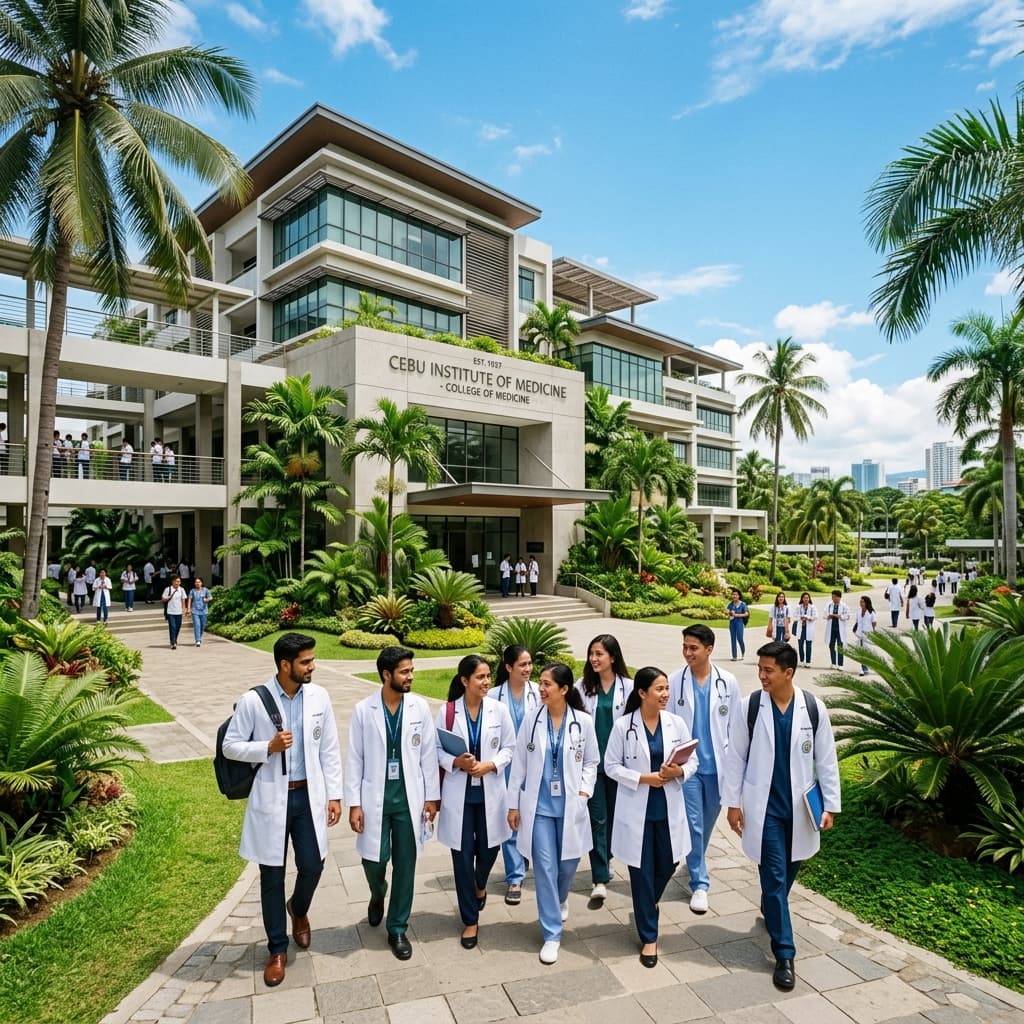
| Cebu Doctors' University College of Medicine | Cebu City | Verify current NMC status |
| AMA School of Medicine | Multiple (Manila/Makati) | Verify current NMC status |
| Our Lady of Fatima University College of Medicine | Valenzuela/Antipolo | Verify current NMC status |
| De La Salle Medical and Health Sciences Institute | Dasmarinas, Cavite | Verify current NMC status |
Critical warning: The Philippine medical sector has over 50 medical schools. The vast majority are NOT on NMC's approved list. Admission to any institution not on the NMC list means your degree will not be valid for NExT registration in India. Do not rely on an agent's claim that a college "is NMC recognized." Verify personally at nmc.org.in and cross-check against WDOMS (wdoms.org).
Fees: What MBBS in the Philippines Actually Costs
Fees in the Philippines are quoted in Philippine Peso (PHP) or USD. Using an indicative exchange rate of ₹1 = PHP 1.5 / $1 = ₹84.
BS Biology + MD (6-year program)
Tuition:
- BS Biology (2 years): PHP 80,000–1,50,000/year = ₹53,000–1,00,000/year
- MD (4 years): PHP 2,00,000–4,50,000/year = ₹1,33,000–3,00,000/year
| University | Approx. Annual MD Tuition | 6-Year Tuition Total (₹) |
|---|---|---|
| University of Santo Tomas (UST) | $7,000–$9,000/year | ₹35–45L |
| Cebu Doctors' University | $5,500–$7,000/year | ₹28–37L |
| AMA School of Medicine | $4,500–$6,000/year | ₹23–31L |
| Our Lady of Fatima | $4,000–$5,500/year | ₹21–29L |
Living costs in Manila (monthly):
- Hostel/dormitory: ₹8,000–15,000/month
- Food: ₹6,000–10,000/month (English-influence cuisine; Filipino food available everywhere; Indian food growing in availability in Manila)
- Transport: ₹2,000–4,000/month
- Personal: ₹2,000–4,000/month
- Monthly total: ₹18,000–33,000
Full 6-year all-in cost (mid-range university):
| Component | 6-Year Total |
|---|---|
| Tuition (BS Bio + MD) | ₹30–40L |
| Accommodation | ₹8–10L |
| Food | ₹5–7L |
| Flights (6 round trips) | ₹3L |
| Insurance, visa, misc | ₹2L |
| Total | ₹48–62L |
This puts the Philippines in the same general cost bracket as Russia and Georgia — not the budget tier of Kyrgyzstan or Uzbekistan.
Language of Instruction
This is the Philippines' most significant structural advantage: instruction is entirely in English, from Day 1 through the final year of MD. There is no language transition, no mandatory Filipino language exam, and no clinical translation challenges.
Filipino patients in hospital settings predominantly speak Filipino (Tagalog) in public hospitals. However, the medical instruction, textbooks, case discussions, and examinations are in English throughout.
For Indian students, this eliminates a significant source of frustration that exists in Russia, Kazakhstan, and even Georgia — where clinical rotations involve some degree of language navigation.
FMGE / NExT Pass Rates: The Honest Data
Historically, FMGE pass rates for Philippine graduates have been moderate — not the highest in the foreign graduate cohort, but not the lowest either. Specific data:
- Overall foreign graduate FMGE pass rate (national): ~18–22%
- Philippine university graduates: Historically 20–30% (varies significantly by institution)
- University of Santo Tomas (UST) graduates: Tend to outperform the national average due to UST's stronger research and clinical exposure
Why pass rates aren't higher despite English instruction: The Philippine MD curriculum is structured for the Philippine Medical Licensure Examination (PNLE) and the USMLE pathway — not the Indian FMGE/NExT pattern. The clinical approach, the high-dose case-based learning style, and the organ-system curriculum at many Philippine colleges aligns better with USMLE Step 1/2 than with the India-specific subject structure of NExT.
This means Indian students at Philippine colleges must supplement their coursework with India-specific NExT preparation — the same discipline required at Russian or Kazakh universities, just for different reasons.
Philippines for USMLE Pathway: The Alternative Career
Here is the context that separates the Philippines from every other MBBS abroad destination for Indian students: hundreds of Indian students annually enroll in Philippine medical schools specifically targeting the USMLE pathway rather than NExT.
Why Philippine Graduates Are Positioned for USMLE
- American medical education legacy: The Philippines was a US territory until 1946. Its medical education system is modeled on the American MD structure, uses American textbooks (Harrison, Robbins, Gray's Anatomy), and aligns with USMLE content.
- USMLE recognition: Philippine MD degrees from recognized institutions are acceptable for USMLE Step 1, Step 2 CK, and Step 2 CS (where applicable) registration via the ECFMG (Educational Commission for Foreign Medical Graduates).
- NCLEX-RN compatibility: For students considering nursing-to-MD transitions (less common), the Philippines also has a strong RN ecosystem.
- English proficiency: No language barrier for USMLE study materials (all in English).
USMLE vs NExT: Which Path to Choose from Philippines
| Factor | NExT (India practice) | USMLE (US practice) |
|---|---|---|
| Exam difficulty | Moderate (subject-wise MCQ + OSCE) | Very high (Step 1, 2, 3 + residency match) |
| Timeline to practice | 2–3 years post-graduation | 5–8 years post-graduation (including residency) |
| Income potential (India) | ₹1–5L/month (varies by specialty/city) | USD $200,000–400,000/year (attending level) |
| Income potential (USA) | N/A | As above |
| Competition | National NExT pool (~60,000+ FMGs) | ECFMG match: 20,000+ IMGs compete annually |
| Certainty | Higher (NMC is a domestic regulator) | Lower (match rate for Indian IMGs is ~50–60%) |
| Investment | Stays in India | Requires USD funds for USMLE fees, coaching, visa |
Verdict: If your goal is practicing medicine in India, NExT is the correct pathway and requires a Philippine college on the NMC approved list. If your goal is a US residency and eventual practice in the US, the Philippines is one of the better starting points — but understand that the USMLE path is longer, more expensive, and not guaranteed.
Manila vs Cebu: City Comparison for Indian Students
Manila
- Philippines' largest city and commercial hub
- Large Indian community; Indian restaurants, grocery stores
- Traffic is severe (Metro Manila is among Asia's worst for commute)
- Home to UST, AMA, Fatima — most prestigious colleges
- Climate: Tropical, hot year-round (27–34°C); typhoon season June–November
Cebu City
- Philippines' second city; cleaner, smaller, less chaotic than Manila
- Growing medical education hub
- Home to Cebu Doctors' University (CDU)
- Closer to beaches and natural environment — quality of life appeal
- Smaller Indian community than Manila but growing
- Climate: Similar to Manila; Cebu is generally less affected by typhoons
For most Indian students: Manila provides more university options and a larger Indian community. Cebu is worth considering specifically for CDU if your research indicates they are currently NMC-recognized.
Admission Process and Eligibility for Indian Students
Eligibility Requirements
- Class 12 with Physics, Chemistry, Biology — minimum 50% aggregate (General) / 40% (SC/ST/OBC)
- Valid NEET qualifying score (NMC cutoff: 50th percentile General, 40th SC/ST/OBC)
- Passed NMAT or university's own entrance test (Philippines' National Medical Admission Test — some universities require this for MD year applicants; check per-institution requirements)
- English proficiency (not separately required for Indian students — Indian medium of instruction in Class 12 is accepted)
Documents for Application
- Class 10 and 12 mark sheets and certificates
- NEET scorecard (must meet NMC cutoff)
- Passport
- Birth certificate
- Medical fitness certificate
- Transfer/Migration Certificate from Class 12 school
- Character certificate
Student Visa Process
Apply for a student visa at the Philippine Embassy, New Delhi or the Philippine Consulate, Chennai/Mumbai. Required documents include the university admission letter, financial documents (bank statement), and standard visa application materials. Processing time: 2–4 weeks typically.
Philippines Bureau of Immigration (BI) Registration
On arrival, foreign students must register with the Philippine Bureau of Immigration. Universities typically assist with this process during orientation week.
Student Life in the Philippines: Indian Student Perspective
Food
Manila has a growing Indian restaurant scene — particularly concentrated in areas like Makati (Greenbelt, Little India area) and certain areas near UST (Sampaloc). Indian grocery stores exist but are not as ubiquitous as in Russia or Kazakhstan's larger Indian communities. Filipino food is heavily influenced by American and Spanish cuisine — rice-based, widely available, and generally palatable to most Indian students. Vegetarians will find options but may need to seek them out deliberately.
Safety
The Philippines has a mixed safety reputation in general media — but within university campuses and dormitory compounds in Manila and Cebu, student safety is well-managed. The relevant caution for Indian students: avoid unfamiliar areas of Manila late at night, particularly in areas outside the university/dormitory zone. Standard urban precautions apply.
Weather
All-year tropical heat (27–34°C) with high humidity. The Philippine typhoon season (June to November) brings heavy monsoon rains and occasional strong typhoons, particularly in the Visayas region. Manila is sometimes in the typhoon path. Flights and infrastructure are occasionally disrupted during strong typhoons. Students from South India and coastal states adapt most easily; students from dry northern India often find the perpetual humidity uncomfortable.
Filipino Culture and Indian Students
Filipinos are generally warm, hospitable, and English-fluent — which makes social integration significantly easier for Indian students compared to CIS countries. The cultural overlap with Indian students is more limited than in Bangladesh but the communal friendliness and language commonality compensate. There is a sizable Indian diaspora in the Philippines (particularly in Metro Manila business districts), which provides informal community support.
Frequently Asked Questions
Is MBBS from Philippines recognized in India in 2026? Only from specific NMC-listed Philippine institutions. The fact that an institution is Philippine does not automatically mean recognition — verify the specific college name on nmc.org.in for the current year's approved list.
What is the total duration for MBBS in Philippines? 6 years: 2 years BS Biology (pre-medical) + 4 years Doctor of Medicine (MD). Students with an existing BSc may qualify for direct MD entry (4 years).
Is Philippines better than Russia for MBBS? Both are viable for India-track students who choose NMC-recognized institutions. Philippines offers full-English instruction and a more comfortable tropical climate. Russia offers a larger Indian community, established FMGE coaching ecosystem, and generally lower fees at regional universities. The decision depends on your language preference, career pathway (USMLE vs NExT), and budget.
Do I need to give NMAT for MBBS in Philippines? Some Philippine universities require NMAT (National Medical Admission Test) as part of the MD program admission criteria. Others do not require it for international students. Check per-institution requirements.
Is Philippine MBBS cheaper than India? Compared to private MBBS in India (Management quota: ₹60L–₹1.5 crore), Philippines is significantly cheaper (₹48–62L all-in for 6 years). Compared to Kyrgyzstan or Uzbekistan, Philippines is more expensive.
Can Philippine MBBS graduates appear for USMLE? Yes — ECFMG accepts Doctor of Medicine degrees from recognized Philippine medical schools for USMLE registration. This is one of the Philippines' structural advantages for students targeting the US medical system.
What is the medium of instruction in Philippine medical colleges? 100% English — from BS Biology through the final year of MD. All textbooks, lectures, clinical rounds, and examinations are conducted in English.
Is it safe to study in the Philippines as an Indian student? Yes — within university campuses in Manila and Cebu, safety is well-managed. Standard urban precautions apply in public areas of Manila. Typhoon season (June–November) occasionally disrupts transportation but institutions are experienced at managing these events.
Summary: Is Philippines Right for You?
Choose Philippines if:
- You want full English-medium instruction with zero language barrier in classes or clinical settings
- You are targeting the USMLE pathway alongside your MD degree
- You enjoy tropical weather and an open, English-speaking social culture
- The specific college you are targeting is verifiably on the current NMC approved list
Do not choose Philippines if:
- The college is not on the current NMC approved list — this is a non-negotiable disqualifier
- Your priority is the absolute lowest fee option (Kyrgyzstan/Uzbekistan are cheaper)
- You want an established, large Indian student community in a single campus (Russia has larger Indian-specific networks)
- You are unfamiliar with the BS Biology + MD two-stage structure and want a straight MBBS equivalent program
Always verify on nmc.org.in before any payment. Speak to current students at your target Philippine university via peer communities — they will tell you exactly what the NMC status situation is and what NExT preparation looks like there.
Related: NMC Eligibility Certificate: How to Apply | MBBS Abroad vs Private India | NEET Cutoff for MBBS Abroad