Why 25,000+ Indian Students Choose MBBS Abroad Every Year
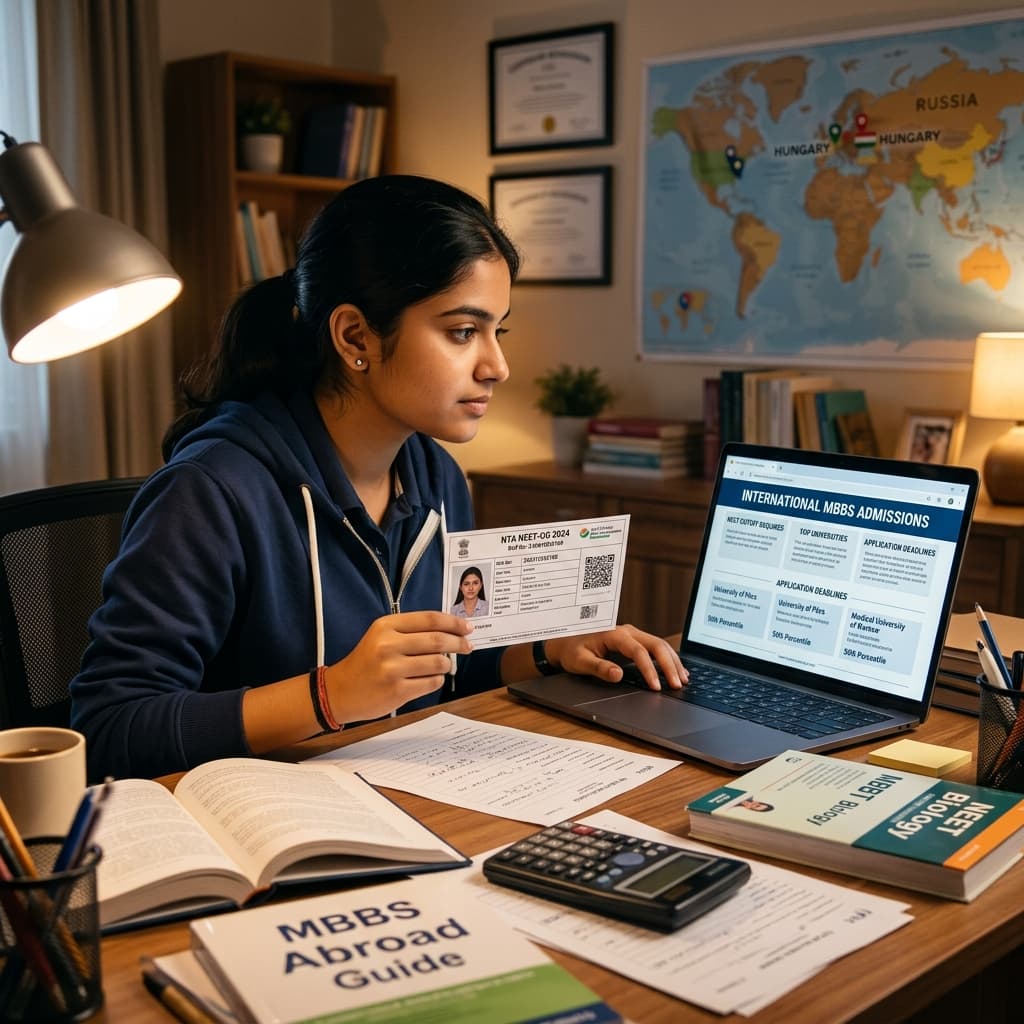
Every year, roughly 200,000 Indian students sit for NEET. Around 93,000 secure an MBBS seat in India. The remaining 100,000+ are left with a choice: wait another year, opt for a lesser-preferred course, or pursue MBBS abroad.
For the last decade, MBBS abroad has been the path taken by a growing share of that group. In 2025–26, estimates suggest over 25,000 Indian students enrolled in MBBS programs outside India, with Russia, Kazakhstan, Bangladesh, the Philippines, Georgia, and Kyrgyzstan accounting for the majority of enrollments.
But "MBBS abroad" is not a monolith. It spans 40+ countries, thousands of universities, wildly different fee structures, and dramatically different clinical training environments. This guide cuts through the noise.
Who Is MBBS Abroad Actually Right For?
Before you read fee tables or university rankings, answer these four questions honestly.
1. Did you clear NEET? NMC regulations require a minimum NEET score to be eligible for MBBS abroad. As of 2025, the cutoff is 50th percentile for General category, 40th for SC/ST/OBC. Without a valid NEET score, no NMC-listed university abroad will give you a degree recognized in India.
2. Can your family realistically fund ₹30–70 lakh over 6 years? MBBS abroad is not cheap if you account for everything — tuition, hostel, food, visa extensions, flights home, study materials, and coaching for the NExT/FMGE screening test. A student who runs out of funds in Year 3 is in a very difficult position.
3. Are you prepared to study in a second language for the first 1–2 years? Even English-medium programs at universities in Russia or Kazakhstan have professors with varying English proficiency. Pre-medical (foundation) years are often conducted partly in the local language. This is a real academic challenge.
4. Do you understand you'll need to pass a screening test to practice in India? The Foreign Medical Graduate Examination (FMGE) — transitioning to NExT — is what stands between your MBBS degree and an Indian medical license. Pass rates have historically been around 15–20%. Preparation begins from Year 1, not after graduation.
If your answers to all four are honest and positive, MBBS abroad is worth considering seriously.
NMC Recognition: The Only Metric That Matters
The National Medical Commission (NMC) is India's apex medical regulatory body. A foreign medical degree is valid in India only if:
- The university appears on NMC's approved list (published periodically, check nmc.org.in)
- The student passed NEET with the required percentile
- The student completes the NExT Part 1 and Part 2 screening tests
Common misconception: Many agents claim their recommended university is "NMC recognized" and show fabricated certificates. Always verify independently on the NMC portal. Filter by country and university name.
NMC also requires that the university be listed in one or more of these directories:
- World Directory of Medical Schools (WDOMS / FAIMER)
- ECFMG (for US licensing)
- WHO World Directory (legacy entries)
A university not in WDOMS is a serious red flag regardless of what an agent claims.
Country-by-Country Overview
Russia
Russia is the largest destination for Indian MBBS students, with over 50 NMC-recognized universities. Medical education in Russia is deeply specialized. The degree is called "General Medicine MD" and is equivalent to MBBS.
Duration: 6 years (including 1-year internship in Russia)
Language: English medium with Russian language taught as a subject
Approximate tuition: $3,500–$8,000/year depending on university
Total cost (6 years): ₹25–45 lakh including living expenses
FMGE pass rate from Russian universities: Varies; top universities like Kazan, Sechenov, RUDN produce better outcomes
Key cities: Moscow, St. Petersburg, Kazan, Novosibirsk
Pros: Established system for Indian students, good clinical exposure in teaching hospitals, large Indian student communities in major cities
Cons: Language barrier in clinical settings, quality varies dramatically between universities, geopolitical considerations post-2022 require updated assessment
Kazakhstan
Kazakhstan has risen sharply in popularity following Russia's geopolitical situation. Several universities like Kazakh National Medical University (KazNMU) and Astana Medical University have strong track records.
Duration: 5 years + 1-year internship
Language: English medium
Approximate tuition: $4,000–$7,000/year
Total cost (6 years): ₹30–50 lakh
Climate: Harsh winters (−20°C in Astana/Nur-Sultan)
FMGE pass rate: Competitive with Russia's top universities
Pros: English-medium instruction, modern university infrastructure, growing NMC list, closer cultural affinity than Russia for many students
Cons: Extremely cold climate in the north, fewer social activities, Almaty is more liveable than Nur-Sultan
Philippines
The Philippines uniquely offers a pre-med BS (Biology/Health Sciences) degree before the MD program — a 4+4 or 5.5-year structure — making it the closest to India's MBBS structure.
Duration: 4 years BS + 4 years MD (or integrated 5.5 years at some universities)
Language: English (official national language for education)
Approximate tuition: $3,500–$6,000/year
Top universities: University of Santo Tomas (UST), Our Lady of Fatima University, AMA School of Medicine
FMGE pass rate: UST graduates historically outperform most other countries
Pros: Full English medium (no language barrier), clinical training in well-equipped hospitals, culturally welcoming environment for Indian students
Cons: Higher upfront cost due to BS degree, typhoon-prone region, the 4+4 structure is not always clearly communicated to students
Georgia
Georgia is emerging as a top destination among students who want European medical education at lower costs. Tbilisi State Medical University and New Vision University are the most prominent.
Duration: 6 years
Language: English medium
Approximate tuition: $5,000–$7,000/year
Total cost (6 years): ₹35–50 lakh
Advantages: EU-compatible degree, relatively mild climate, safe country with well-developed tourism infrastructure
Pros: European curriculum, good quality teaching hospitals, small class sizes, relatively safe and accessible
Cons: Fewer Indian students means less peer support infrastructure, limited direct flights from India
Vietnam
Vietnam is an emerging and underrated MBBS destination for Indian students. Several universities are listed in the World Directory of Medical Schools (WDOMS/FAIMER), and a growing number have obtained NMC approval. The country offers tropical climate, low cost of living, and English-medium programs — all at fees significantly lower than Russia or Kazakhstan.
Duration: 6 years
Language: English medium at international programs (Vietnamese language classes included)
Approximate tuition: $3,000–$5,000/year
Total cost (6 years): ₹30–45 lakh including living expenses
Key universities: University of Medicine and Pharmacy Ho Chi Minh City (UMP-HCMC), Hanoi Medical University, Hue University of Medicine and Pharmacy
Pros: Lowest cost of living among all MBBS abroad destinations, warm tropical climate year-round, safe and welcoming country, Indian food easily available in major cities, growing NMC recognition
Cons: Fewer established Indian student communities compared to Russia/Kazakhstan, language barrier in clinical settings (Vietnamese-speaking patients), NMC recognition limited to specific universities — always verify current list
Kyrgyzstan
Kyrgyzstan is the budget option, with tuition fees as low as $2,500–$4,000/year. However, the clinical training quality and FMGE outcomes are generally lower than other countries.
Duration: 5–6 years
Language: English medium (with Kyrgyz/Russian in clinical settings)
Approximate tuition: $2,500–$4,000/year
Key concern: Several universities here have been flagged by NMC; always verify the specific university
Full Cost Breakdown: What Nobody Tells You
Indian students and parents often see tuition fees quoted in advertisements. The actual cost of MBBS abroad is substantially higher. Here is a realistic breakdown for a 6-year program in Russia (mid-tier university):
| Cost Component | Amount (₹) |
|---|---|
| Tuition (6 years × ₹3.5L) | ₹21,00,000 |
| Hostel (6 years × ₹1.5L) | ₹9,00,000 |
| Food & daily expenses (6 years × ₹1.5L) | ₹9,00,000 |
| Flights (6 round trips) | ₹3,00,000 |
| Visa fees and extensions | ₹60,000 |
| Medical insurance | ₹1,20,000 |
| Study materials and textbooks | ₹60,000 |
| NExT/FMGE coaching after degree | ₹3,00,000 |
| Total realistic estimate | ₹47,40,000 |
For Philippines or Georgia, add approximately ₹5–10 lakh to the total due to higher tuition. For Kyrgyzstan, the total can be ₹5–8 lakh lower — but with the corresponding trade-offs in training quality.
Eligibility Requirements (2025–26)
| Requirement | Details |
|---|---|
| Age | 17 years on or before 31 December of admission year |
| NEET | Mandatory; minimum 50th percentile (General), 40th (SC/ST/OBC) |
| 10+2 Science | Physics, Chemistry, Biology — minimum 50% aggregate (General), 40% (SC/ST/OBC) |
| English proficiency | Most universities require Class 12 English; some require IELTS/TOEFL (verify per university) |
| Medical fitness | Standard medical certificate required |
The Admission Timeline
Most universities abroad follow either a September/October intake or a February/March intake. The admission cycle for a September 2025 intake typically looks like this:
- January–March 2026: Research countries and universities, shortlist 3–5 options
- April–May 2026: NEET exam
- June 2026: NEET results; confirm shortlist
- June–July 2026: Apply to universities, submit documents
- July–August 2026: Receive admission letters, arrange finances
- August 2026: Apply for student visa (allow 4–6 weeks processing time)
- September 2026: Depart and begin pre-medical orientation
Documents typically required: 10th and 12th mark sheets and certificates, NEET scorecard, passport (valid for 5+ years), passport photos, medical certificate, gap certificate (if applicable), affidavit of financial support.
What the First Year Is Really Like
Most students arrive expecting a campus experience similar to what they have seen in videos shared by consultants. The reality requires adjustment.
Pre-medical year (Foundation year): Many universities, especially in Russia and Kazakhstan, require a foundation year to learn the local language at a basic level and to adjust to the teaching style. This year is academically different — less clinical, more orientation-focused.
Classroom teaching style: Unlike India's NEET-style multiple-choice preparation, Russian and Eastern European medical universities use oral exams, written dissertations, and practical lab assessments. Students accustomed to MCQ coaching need to reorient.
Clinical posting structure: In Russia, clinical postings at teaching hospitals typically begin from Year 3 or 4. The quality depends heavily on the hospital affiliation. Top universities in Kazan or Moscow have excellent teaching hospitals; smaller cities may not.
Hostel life: Most universities provide on-campus hostels. Conditions vary from basic dormitory-style rooms to modern single-occupancy rooms. Food can be a challenge — many students cook their own Indian meals.
The NExT Screening Test: Your Path Back to India
The Foreign Medical Graduates Examination (FMGE) is being replaced by the National Exit Test (NExT). Under the new system, foreign medical graduates will need to pass both NExT Part 1 (theory) and NExT Part 2 (clinical skills) to obtain a provisional license to practice in India.
Historical FMGE pass rates (to calibrate expectations):
- Overall pass rate: ~15–20%
- Top universities in Russia/Philippines: 30–45%
- Bottom-tier universities: <10%
This is not an exam you can prepare for only after returning. Students who consistently perform well in their MBBS program — particularly in subjects like Anatomy, Physiology, Biochemistry, Pathology, Pharmacology — and who supplement their university coursework with India-focused revision have significantly higher pass rates.
Recommended preparation approach:
- Use Indian standard textbooks alongside university material (Grant's Atlas, Robbins Pathology, KD Tripathi Pharmacology)
- Join a monthly online test series from Year 2 onwards
- Connect with seniors at your university who have successfully cleared FMGE/NExT
Red Flags: How to Spot a Bad University or Agent
University-level red flags:
- Not listed in WDOMS/FAIMER directory
- Not on current NMC approved list
- No teaching hospital affiliation mentioned clearly
- Claims of "guaranteed FMGE coaching" included in fees (this is a sales tactic, not a quality indicator)
- Tuition fees suspiciously lower than market rates
Agent-level red flags:
- Promises of admission with low NEET scores (below NMC cutoff)
- Upfront payment demands before any documentation
- Vague answers about which specific university you're applying to
- No registered office or verifiable track record
- Claims that "NMC recognition is being processed" (a university must already be recognized before you enroll)
How Students Traffic Approaches This Differently
Most consultancies profit from placing students at specific universities, creating an inherent conflict of interest. Students Traffic's peer model works differently: we connect prospective students with Indian students already enrolled at specific universities abroad. You get an honest answer because the peer gives you the same advice they'd give their younger sibling.
Before deciding, talk to at least two current students at any university you're considering. Ask them about: clinical exposure, food situation, internet connectivity, hostel conditions, FMGE preparation resources, and whether they'd make the same choice again.
Frequently Asked Questions
Is MBBS abroad recognized in India? Yes, if the university is on NMC's approved list, you passed NEET, and you clear the NExT screening exam after returning.
Which country is best for MBBS abroad for Indian students? There is no single answer. Russia and Kazakhstan offer the best combination of cost, NMC approval numbers, and established Indian student communities. Philippines offers strongest English medium and better FMGE outcomes from top universities. Georgia offers European curriculum quality. The "best" depends on your budget, language preference, and risk tolerance.
Can I do internship in India after MBBS abroad? Under current NMC rules, foreign medical graduates must complete their internship abroad as part of their university program and then appear for NExT. There is no separate Indian internship pathway for foreign graduates as of 2024.
What happens if FMGE/NExT is discontinued? NExT is the replacement, not the discontinuation of the screening requirement. All foreign medical graduates will still need to pass NExT Part 1 and Part 2 to practice in India.
Is studying MBBS abroad worth it? For students who: (a) have a genuine NEET score, (b) choose a well-recognized university, (c) prepare seriously for NExT throughout their degree, and (d) have financial security for 6 years — yes, MBBS abroad can be a viable and rewarding path to becoming a doctor.
How much does MBBS abroad cost in total? Realistically, budget ₹35–55 lakh for Russia or Kazakhstan, ₹45–65 lakh for Philippines or Georgia, and ₹25–35 lakh for Kyrgyzstan — all-inclusive over 6 years.
The Bottom Line
MBBS abroad is not a shortcut, and it is not a trap. It is a legitimate pathway that requires careful university selection, realistic financial planning, and sustained academic effort throughout the program.
The students who succeed are those who approached the decision with clear eyes — understanding the NExT requirement before enrolling, choosing their university based on verifiable data, and starting their India-specific exam preparation from Year 1.
The students who struggle are those who relied on an agent's word, chose a university based on lowest fees alone, or discovered the FMGE/NExT requirement only after returning to India.
Use the peer connect feature on Students Traffic to speak with students already at universities you're considering. No marketing, no sales pitch — just a conversation with someone who is living the experience you're about to choose.